AI Sales Intelligence Platform for Banks: How to Choose One That Reaches Production
A bank-specific guide to AI sales intelligence: the vendor categories, production requirements, pilot traps, and 25 RFP questions every banking team should ask before choosing a platform.
An AI sales intelligence platform for banks should do more than summarize CRM activity. It should connect relationship, transaction, product, hierarchy, and external signals; resolve clients across entities and households; and surface explainable next-best actions inside the relationship manager's existing workflow. The strategic case for AI in banking is clear, but many institutions still stall between pilot and production. The difference often comes down to platform fit: whether the system was built for banking data, banking workflows, and banking governance from the start.
Table of Contents
- Why AI Sales Intelligence Is Becoming a Banking Priority
- What the Value at Stake Looks Like for Banks
- Why Banking AI Sales Pilots Stall
- The AI Sales Vendor Landscape for Banks
- What an AI Sales Intelligence Platform for Banks Actually Needs to Do
- Four Banking and BFSI Patterns in Practice
- The 25-Question AI Sales Platform Evaluation Framework
- How to Choose the Right Category and Platform
- FAQ
Introduction
AI sales intelligence is no longer a banking experiment. The hard part is choosing a platform that can handle bank data, client hierarchies, transaction signals, CRM workflow, and deployment requirements well enough to move beyond pilot.
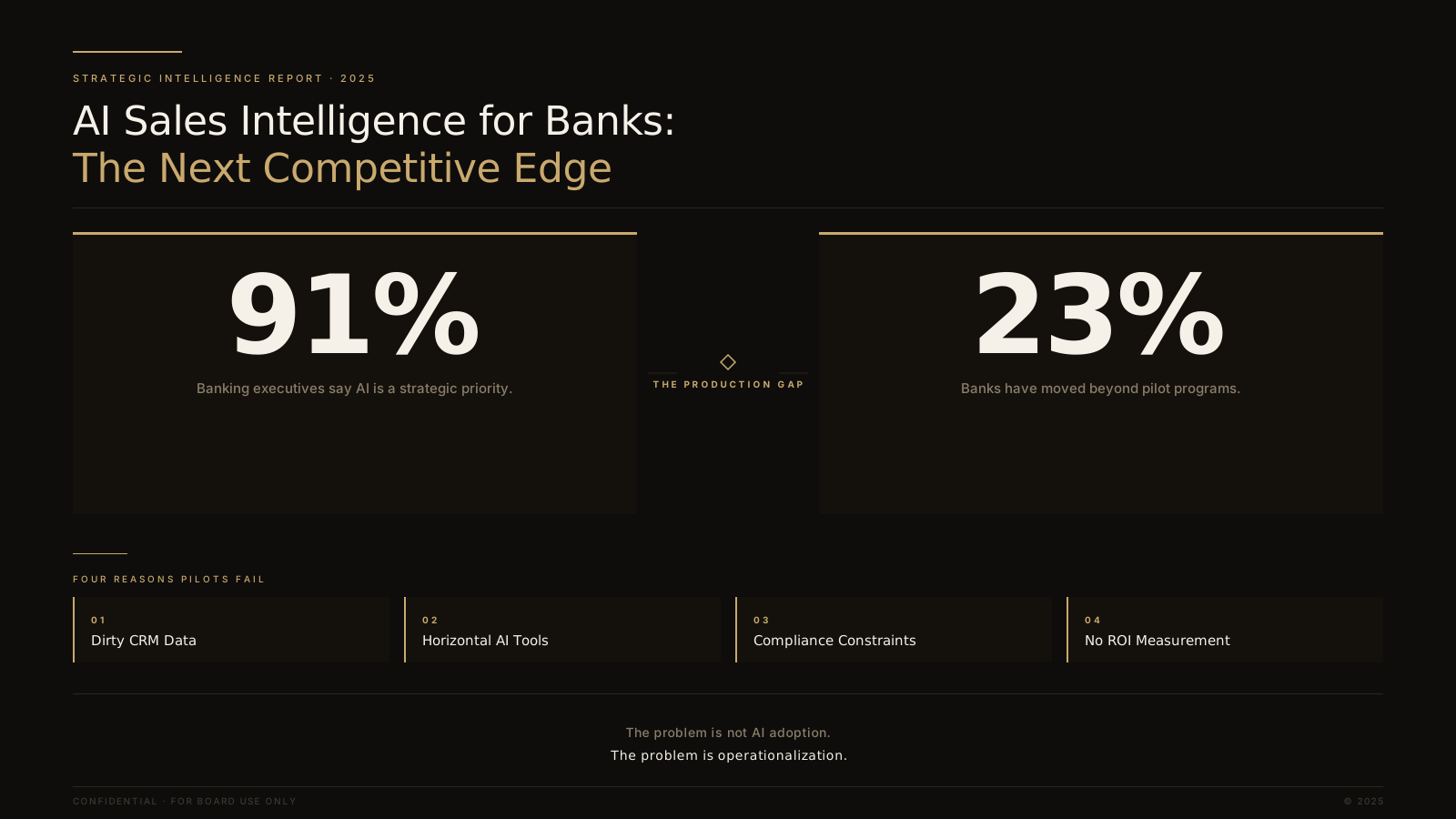
AI sales intelligence is now a board-level priority across banking. Accenture's Q1 2026 banking survey found that 91% of executives consider AI a strategic priority. McKinsey estimates the productivity value for banking at $200 billion to $340 billion annually, with broader addressable value tied to revenue, risk reduction, and new product opportunities. The strategic case is established. The operational question is harder: which AI sales platform can actually make it through bank data, workflow, and governance realities?
The gap between declared priority and production deployment is not only a budget problem or an appetite problem. It is often a platform-selection problem. CRM-native AI, conversation intelligence, revenue intelligence, account intelligence, signal detection tools, and purpose-built AI sales intelligence platforms for banks are built around different data models and selling motions. Those differences may not be obvious in a demo. They show up when the bank tests entity resolution, connects transaction data, reviews auditability, and asks relationship managers to use the output inside their normal workflow.
Horizontal AI sales tools can be valuable, but they often miss the requirements that make banking different. Commercial banks, regional banks, lenders, and wealth teams need systems that understand multi-entity client relationships, product utilization, treasury and deposit behavior, relationship ownership, and explainable next-best actions. A tool that works for a SaaS inside-sales team may not be ready for a relationship banking environment.
This article maps the AI sales vendor landscape for banks, defines what a banking-ready platform needs to do, and provides a 25-question evaluation framework for the RFP, short-list memo, or executive buying committee.
Why AI Sales Intelligence Is Becoming a Banking Priority
Three forces are converging.
Margin pressure is changing the sales mandate. McKinsey's analysis shows global banking profit pools (~$1.2T) could shrink as much as 10% over the next 5–10 years if banks fail to reinvent business models (McKinsey, "Agentic AI will shake up banking"). AI leaders could open a 4 percentage point ROTE gap over laggards. The status-quo motion is losing.
Relationship manager capacity is too expensive to waste. RMs spend ~60% of time on non-selling tasks (Salesforce, State of Sales). For a bank with 200 commercial RMs at $300K loaded cost, that is $36M of recoverable productivity annually before any revenue uplift. The CFO math has changed.
The data and AI substrate has matured. LLM-agnostic decisioning, entity resolution at production scale, private deployment environment deployment, and agentic execution with human-in-the-loop are now production-ready. The technology that was speculative in 2023 is procurable in 2026.
When margin pressure, RM productivity, and production-ready AI infrastructure converge, banks no longer evaluate AI sales intelligence as a side experiment. They evaluate it as a way to make relationship coverage more precise, more timely, and more measurable. The institutions that move past pilots will be the ones that choose platforms around banking data and RM workflow, not generic AI demos.
What the Value at Stake Looks Like for Banks
The McKinsey 2026 banking AI research is the clearest reference data available.
For bank buyers, the headline number is less useful than the workflow question behind it: where can AI reduce manual analysis, improve coverage timing, and help RMs act on signals that already exist across core banking, CRM, treasury, loan, product, and external data sources?
Productivity value. $200B–$340B in annual productivity from generative AI and advanced analytics across global banking. The number alone is too large to act on — but the per-bank decomposition is operational.
Revenue and cost benchmarks. Banks that rewire a single frontline domain end-to-end: 3–15% higher revenue per relationship manager and 20–40% lower cost to serve (McKinsey, "Agentic AI in banking"). For a $5B revenue bank with 150 RMs, the 3–15% range translates to ~$150M–$750M in incremental annual revenue against a baseline 100% selling-time RM, conservatively pro-rated.
Specific case studies cited. One commercial bank's RMs using AI-generated lead lists achieved 2x conversion versus traditional sources. One retail bank deployed binary classification models for cross-sell propensity at the customer level — up to 2x conversion rate from enhanced targeting; piloted with 50+ reps across 5 channels and 8,000 customers. One bank's product recommender + next-best-action engine connected to a virtual assistant has a goal of driving 30% of revenue through AI-enabled chatbot interactions within three years.
Profit pool risk. Profit pools shrinking 10% if business models do not reinvent; 4-point ROTE gap between leaders and laggards. This is the strategic urgency.
These figures form the business case. They are not vendor-specific. Any platform that delivers against these benchmarks for the bank's specific motion is worth evaluating. The platform that does not is not.
Why Banking AI Sales Pilots Stall
Accenture's Q1 2026 banking executive survey shows the familiar gap: high strategic priority, much lower production adoption. The pattern is not that banks lack interest in AI. It is that many pilots are scoped around demos instead of the operating conditions that decide whether the platform will scale.
Reason 1 — The CRM is not enough. Pilots often start with CRM data because it is easiest to access. In banking, that usually means the model is missing the client hierarchy, product footprint, transaction behavior, and relationship context needed to make useful recommendations. The result is a polished AI layer sitting on incomplete inputs. See dirty CRM data in financial services for the deeper diagnostic.
Reason 2 — The platform was built for a different sales motion. A horizontal AI sales tool may work well for SaaS-style pipeline inspection, rep coaching, or outbound prioritization. Relationship banking is different. The platform has to understand complex entities, regulated workflows, multi-product relationships, and the fact that the RM's trust determines adoption.
Reason 3 — Deployment and governance questions come too late. A vendor may look procurement-ready until the evaluation reaches deployment posture, audit logging, model lineage, data residency, access controls, or internal risk review. Surface those questions in week one, not after a six-month pilot.
Reason 4 — The pilot is not instrumented. A pilot that does not measure adoption, recommendation accuracy, conversion lift, RM productivity, and revenue attribution will struggle to earn executive support. The platform should make performance measurement part of the operating model, not a manual spreadsheet after the fact.
These issues compound. The lesson is not that AI sales intelligence fails in banking. The lesson is that banks need to evaluate platform fit against their real sales motion, data environment, governance needs, and measurement model before the contract is signed.
The AI Sales Vendor Landscape for Banks
The market is more crowded than the buyer needs it to be. Six categories cover what is actually being purchased.
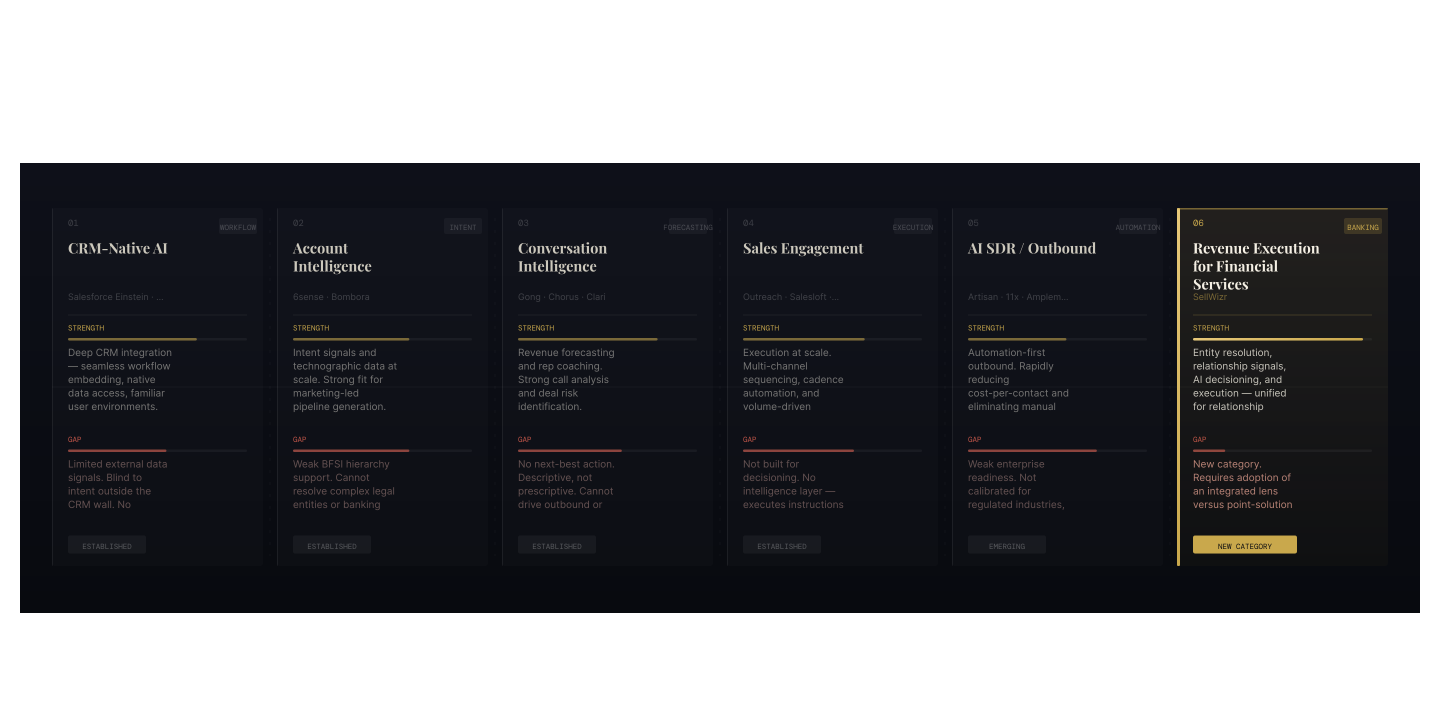
Note on method: The categories below describe general architectural characteristics and typical strengths and gaps. They are not named-vendor assessments and should not be read as a competitive ranking of specific products.
Category 1 — CRM-native AI. Strength: deeply integrated with the system of record; no additional UI; familiar procurement. Gap: limited to the CRM's data model; weak on cross-system entity resolution and transaction-data ingestion. Best for: banks where the CRM holds 70%+ of the relevant data and the LOB does not require external transaction signals.
Category 2 — Account intelligence / intent. Strength: top-of-funnel intent signal; account prioritisation. Gap: B2B SaaS-oriented; weak on BFSI transaction data and multi-entity hierarchies; not designed for relationship-banking motions. Best for: the small-business/SBA-style top-of-funnel motion at smaller banks; less fit for relationship banking.
Category 3 — Conversation / pipeline intelligence. Strength: conversation capture, rep coaching, forecast accuracy. Gap: describes what happened in the pipeline; does not decide next-best action; does not unify external data; pricing favours inside-sales teams. Best for: sales coaching and forecast governance, not relationship-led decisioning.
Category 4 — Sales engagement. Strength: outbound sequence execution and channel routing. Gap: delivery, not decision; not relationship-led; not BFSI-data-aware. Best for: delivery layer in mixed stacks; complementary to decisioning, not a substitute.
Category 5 — AI SDR / outbound AI (newer entrants). Strength: top-of-funnel automation at low cost per touch. Gap: not enterprise-grade; rarely BFSI-compliant; not aligned with relationship banking trust. Best for: greenfield outbound at smaller institutions; not the right fit for tier-1 or tier-2 relationship motions.
Category 6 — Revenue execution for financial services. Strength: built around BFSI data complexity, entity resolution, signal detection, explainable next-best action, and CRM workflow activation. Gap: newer category language; buyers may need to educate internal stakeholders on how it differs from revenue intelligence, CRM-native AI, or conversation intelligence. Best for: commercial banks, regional banks, wealth firms, asset managers, and transaction banking teams where multi-entity hierarchies, product data, and signal-to-action workflows matter.
These categories are not mutually exclusive. Mature BFSI stacks typically run two to three together: CRM-native AI for in-CRM scoring, conversation intelligence for coaching, and revenue execution for relationship-led decisioning. The mistake is treating any one category as sufficient.
What an AI Sales Intelligence Platform for Banks Actually Needs to Do
A working AI sales intelligence platform for banks must do five things horizontal platforms typically do not.
1. Resolve banking client hierarchies natively. Holding companies, subsidiaries, guarantors, funds, trusts, households, and related accounts need to be modeled as real relationship structures, not flattened into duplicate CRM records. The platform should support deterministic and probabilistic matching, confidence scoring, and visible lineage. This is the client hierarchy visibility layer most horizontal vendors duck.
2. Ingest transaction, product, and relationship data. The signals that matter in banking often live outside CRM activity. Deposit patterns, fund flows, lending utilization, treasury volumes, product gaps, holdings changes, service history, and relationship coverage all need to feed the intelligence layer — internal and external data combined.
3. Turn signals into ranked, explainable next-best actions. The output should not stop at a score, alert, or summary. It should give the RM a prioritized action, explain why the action matters, show the source signals, and make the next step easy to review.
4. Fit into the RM's existing workflow. Recommendations should appear where the relationship manager already works, such as CRM, inbox, calendar, or task queue. The platform should route explainable recommendations into the CRM instead of adding another screen.
5. Support the bank's deployment and governance requirements. Private, institution-managed, or controlled deployment options; audit logs; model lineage; access controls; and region-aware data handling should all be part of the evaluation, mapped to the bank's own internal review process.
The practical test is simple: can the platform demonstrate these capabilities against the bank's data, users, and deployment expectations before the pilot is declared successful? Many horizontal tools can show two or three. A banking-ready AI sales intelligence platform needs to show all five.
Four Banking and BFSI Patterns in Practice
Four operational patterns drawn from McKinsey's documented cases and the institutional-sales motion.
Pattern 1 — Commercial banking cross-sell from resolved client data. A commercial bank deployed an AI engine that ingested core banking, transaction warehouse, and CRM data. Entity resolution mapped subsidiaries to parent holding companies. The engine surfaced ranked cross-sell actions and an agentic layer prepared the outreach and briefing for the RM to approve. McKinsey reports the resulting RMs achieved 2x the conversion rate of traditional lead sources. The win was not the model — it was the resolved entity feeding a working agentic execution loop.
Pattern 2 — Product recommendation across digital and RM channels. A bank's product recommender + next-best-action engine is connected to its virtual assistant; the stated goal is 30% of revenue driven through AI-enabled chatbot interactions within three years (McKinsey). The pattern requires unified product, household, and signal data — the same substrate the RM-facing recommender uses — backed by a unified client profile.
Pattern 3 — Treasury opportunity from a deposit or cash-management signal. A regional commercial bank holds the parent treasury relationship. A subsidiary's deposit pattern signals a treasury product need. Hierarchy-aware entity resolution maps the subsidiary to the parent; the buying signal detection layer detects the pattern; the decisioning layer ranks the action; the agentic execution layer drafts the outreach, prepares the briefing, and routes to the parent's coverage RM for approval. The RM reviews, edits, sends. The opportunity converts.
Pattern 4 — Institutional manager-search capture from a consultant signal. An asset manager's strategy is moved to a "Buy" rating by a major investment consultant, and three of that consultant's pension and endowment clients are mid-way through asset-allocation studies in the same asset class. None of it is in the CRM; it lives in consultant research notes, board minutes, and the institutional team's heads. An AI sales intelligence platform ingests the consultant rating change and the public board-meeting calendars, resolves each allocator to its consultant of record and the firm's existing relationship history, and ranks the opportunity: high-conviction, consultant-endorsed, board decision inside the quarter. The agentic layer drafts the consultant-relations outreach and an RFP-readiness brief tailored to each plan's mandate size and guidelines; the Head of Consultant Relations approves and sends. This pattern belongs in the article because many banking AI evaluations expand beyond the bank branch or commercial RM into adjacent BFSI distribution motions where signal quality, entity resolution, and workflow timing decide whether a seller can act.
Across the examples, AI is the visible layer. The harder work sits underneath: resolving the right entity, recognizing the signal, ranking the action, and routing it to the right human workflow. That is the difference between a useful banking AI assistant and a platform that can support revenue execution for financial services.
The 25-Question AI Sales Platform Evaluation Framework
Use these questions to separate demo-ready AI from production-ready bank sales intelligence. The goal is not to ask whether the platform has AI. The goal is to understand whether it can connect banking data to explainable action in a workflow RMs will use.
A defensible RFP for a banking AI sales intelligence platform covers seven dimensions and 25 questions.

Dimension 1 — Data model and entity resolution (4 questions)
- Does the platform natively model holding companies, subsidiaries, funds, trusts, and households as first-class objects?
- Does it use both deterministic and probabilistic matching, with explainable confidence scores?
- Can it resolve a single household across spouses, trusts, LLCs, and UTMA accounts in a live demo against our data?
- Does it maintain a golden record with documented lineage from each source system?
Dimension 2 — Signal layer (4 questions) 5. What specific BFSI signals does the platform detect (deposit patterns, fund flows, transaction trends, life events, KYC updates, corporate actions, news)? 6. What is the time-to-signal latency from source-system event to in-CRM action? 7. How are signals scored for revenue relevance against the resolved entity? 8. Can we add custom signals (e.g., portfolio drift, internal coverage gap) without vendor engineering?
Dimension 3 — Decisioning (4 questions) 9. Is the next-best action ranked across all candidate actions for the resolved entity? 10. Is the model LLM-agnostic — can we choose our model and switch without re-implementing? 11. Is every ranking decision explainable with source signals and model reasoning? 12. Can the platform be tuned per LOB without re-platforming?
Dimension 4 — Agentic execution and workflow (3 questions) 13. Does the platform have AI agents that pick up the ranked next-best action and execute it — drafting outreach, preparing briefings, queuing follow-ups, running enrichment — with the RM approving, editing, and sending? 14. Does the RM stay in their existing workflow (CRM, inbox, calendar) for approval, or are they pushed into a separate UI? 15. How are agent actions reconciled with the CRM as system of record, and how are they made idempotent under high-volume conditions?
Dimension 5 — Deployment and compliance (4 questions) 16. Does the platform support private deployment environment, institution-managed environment, or air-gapped deployment? 17. What is the full audit logging coverage — signals, model calls, ranked actions, agent actions, and human approvals? 18. What is the data residency posture by region (US, EU, UK, Canada, APAC)? 19. What security, privacy, and compliance documentation can the vendor provide for internal review, and which claims are formally verified?
Dimension 6 — Adoption and change management (3 questions) 20. What is the typical adoption curve over 90 / 180 / 365 days, by RM cohort? 21. What change-management resources does the vendor provide? 22. What is the typical time-to-first-ranked-action for a scoped first deployment?
Dimension 7 — ROI measurement (3 questions) 23. How is incremental revenue per RM measured? 24. How is cross-sell conversion uplift measured against baseline? 25. How is cost-to-serve reduction measured and attributed?
Use this framework verbatim or adapt to the bank's specific governance. Vendors that cannot answer 20+ of these in detail should not advance to short-list.
How to Choose the Right Category and Platform
The category-fit decision is more important than the platform decision. Three rules.
Rule 1 — Match the category to the banking motion. Inside-sales coaching, top-of-funnel intent, outbound sequencing, and relationship-led banking decisioning are different jobs. Choose the category that matches the workflow you are trying to change.
Rule 2 — Evaluate the data substrate before the AI interface. The entity-resolution and transaction-data ingestion questions should be tested early. A vendor that cannot resolve a complex banking relationship or ingest relevant source data will not improve simply because the UI looks strong. A single source of truth for revenue data is what makes the AI interface trustworthy.
Rule 3 — Bring governance into the first evaluation meeting. Deployment posture, auditability, model lineage, access control, data handling, and internal review requirements should shape the short list from the beginning.
For commercial banks, regional banks, and asset managers — where multi-entity hierarchies, transaction signals, and controlled deployment expectations matter — revenue execution for financial services is often the better category fit than a horizontal sales AI tool. The right platform is the one that can score strongly on the 25-question framework against the bank's own data, workflow, and governance requirements.
Conclusion
The value case for AI in banking is no longer the hard part to explain. The harder question is whether the bank can choose a platform that survives the move from executive interest to production workflow.
For relationship banking, that means looking past generic AI sales claims. A banking-ready AI sales intelligence for banks platform should resolve client hierarchies, ingest transaction and product signals, recommend explainable next-best actions, write back into the CRM or RM workflow, and support the bank's deployment and governance expectations.
The 25-question framework gives buying teams a practical way to test that fit. It helps separate platforms that can impress in a controlled demo from platforms that can support commercial banking, regional banking, wealth, and institutional sales teams in the field.
Banks that close the pilot-to-production gap will not do it by adding another dashboard. They will do it by connecting the data they already have to the relationship actions their teams can actually take.
Summary. AI sales intelligence for banks is moving from experimentation to platform evaluation. The strongest use cases require more than CRM summaries or generic sales AI. Banks need entity-resolved client context, transaction and product signals, explainable next-best actions, CRM workflow integration, and clear deployment/governance review. The six vendor categories — CRM-native AI, account intelligence, conversation intelligence, sales engagement, AI SDR, and revenue execution for financial services — serve different sales motions. For relationship banking, the best-fit category is the one that can connect banking data to RM-ready action and prove value against adoption, conversion, productivity, and revenue measurement.
FAQ
What is an AI sales intelligence platform for banks?
An AI sales intelligence platform for banks connects client, account, transaction, product, CRM, relationship, and external data to help banking teams identify the right next action for each relationship. Unlike generic sales AI, a bank-ready platform needs to understand client hierarchies, product usage, transaction signals, RM workflows, and governance requirements.
How do banks use AI sales intelligence?
Banks use AI sales intelligence to prioritize relationship manager outreach, identify cross-sell and treasury opportunities, surface product gaps, prepare client briefings, detect changes in account behavior, and route explainable next-best actions into CRM or existing RM workflows.
Why do AI sales pilots fail in banking?
Banking AI sales pilots often fail when they rely only on CRM data, ignore multi-entity client relationships, cannot ingest transaction or product data, add a separate workflow RMs do not use, or surface governance and deployment issues too late in the evaluation.
What should banks look for in an AI sales intelligence platform?
Banks should evaluate entity resolution, transaction and product data ingestion, signal detection, explainable next-best action, CRM workflow integration, deployment options, auditability, adoption measurement, and revenue attribution.
Is AI sales intelligence the same as revenue execution for financial services?
No. AI sales intelligence usually refers to the insight and recommendation layer. Revenue execution for financial services is broader: it connects data unification, entity resolution, signal detection, next-best action, workflow activation, and measurement into a repeatable operating system for revenue teams.
Does AI sales intelligence replace the CRM?
No. A banking AI sales intelligence platform should complement the CRM by improving the quality of recommendations, actions, and context inside the existing workflow. The CRM remains the system of record; the AI layer helps make the data more actionable for relationship teams.
What banking signals should an AI sales platform detect?
Relevant signals can include deposit changes, treasury activity, lending utilization, product gaps, fund flows, holdings shifts, relationship coverage gaps, external news, corporate events, and client hierarchy changes. The right signal set depends on the bank's line of business and coverage model.
What is the first step for a bank evaluating AI sales intelligence?
Start by defining the banking sales motion the platform must support. Then test whether the vendor can resolve real client hierarchies, ingest relevant source data, produce explainable next-best actions, and fit into the RM workflow before expanding the evaluation.
See how SellWizr supports bank sales intelligence
Explore how SellWizr connects client hierarchy, transaction, product, CRM, and external signals into explainable next-best actions for banking and financial-services teams.