Why Banks Need Client 360 Intelligence, Not Another Profile Screen
A real Client 360 platform for banks is hierarchy-aware, signal-enriched, and action-oriented. It does more than display client data; it helps relationship managers decide what to do next.
A real Client 360 platform for banks is hierarchy-aware, signal-enriched, and action-oriented. It resolves the multi-entity legal structures — holding companies, subsidiaries, funds, trusts, households, advisors, consultants — that a flat CRM account model cannot describe. It joins that resolved client to transaction, product, market, and registry signals that change week over week. It then writes ranked next-best actions back into the CRM the relationship manager already uses. Salesforce Financial Services Cloud, Microsoft Dynamics 365, and data warehouses remain important systems of record and analysis. Operational Client 360 is the intelligence layer above them.
Table of Contents
- What Most Banks Call "Client 360" Is Usually a Profile Screen
- The Five Capabilities a Real Banking Client 360 Must Deliver
- Why Generic Customer 360 Features Fall Short in Financial Services
- How a Hierarchy-Aware Client 360 Works in Four BFSI Scenarios
- The Intelligence Layer Above Your CRM
- How to Evaluate a Client 360 Platform for Banks
- What Banks Should Measure After Launch
- Conclusion
- FAQ
Introduction
Most Client 360 projects in banking start with a reasonable promise: give the relationship manager one place to see the client. Accounts, contacts, recent interactions, holdings, products, open opportunities, service history, and pipeline stage all appear on one screen.
That is useful. It is not enough.
A unified profile helps an RM see more context, but it does not decide which client needs attention this week, which subsidiary changed behavior, which household relationship is undercovered, or which treasury, lending, wealth, or markets opportunity is now active. The RM still has to interpret the data, search across systems, and translate scattered clues into a next step.
The issue is not that banks chose the wrong CRM. Salesforce Financial Services Cloud, Microsoft Dynamics 365, and other enterprise CRMs are valuable systems of record. The issue is that a CRM profile screen is not designed to resolve complex legal hierarchies, monitor transaction and external signals, rank client opportunities, and write action-ready recommendations back into the RM workflow.
A real Client 360 platform for banks works above the CRM as an intelligence layer. It resolves multi-entity relationships across holding companies, subsidiaries, funds, trusts, households, and related contacts. It enriches the client view with internal and external data. Then it turns that context into ranked next-best actions the RM can review, trust, and act on.
This article explains what separates an operational Client 360 from a dashboard, the five capabilities a banking Client 360 must deliver, and how financial institutions should evaluate platforms that claim to provide a complete client view.
What Most Banks Call "Client 360" Is Usually a Profile Screen
In banking, three different things are often called Client 360. Only one changes coverage behavior.
The profile-screen version gives the RM one interface for accounts, contacts, holdings, service history, activities, and pipeline. It reduces tab switching, but the RM still has to decide what matters.
The warehouse version creates a central data layer in Snowflake, Databricks, or a similar environment. It is valuable for analytics, reporting, governance, and enterprise data strategy. But most RMs do not query a warehouse before a client call.
The intelligence-layer version resolves the client, enriches the profile with live internal and external signals, ranks the next best actions, and pushes those actions into the CRM. This is the version that changes the way bankers, advisors, wholesalers, and institutional coverage teams work.
The difference is simple: a dashboard shows what happened. An operational Client 360 helps the team decide what to do next.
A visible sign that a Client 360 program stopped at the profile-screen stage is spreadsheet survival. If RMs still keep private trackers to remember parent/subsidiary relationships, warm intro paths, renewal risks, product gaps, or timing signals, the bank has not yet built a true Client 360 intelligence layer.
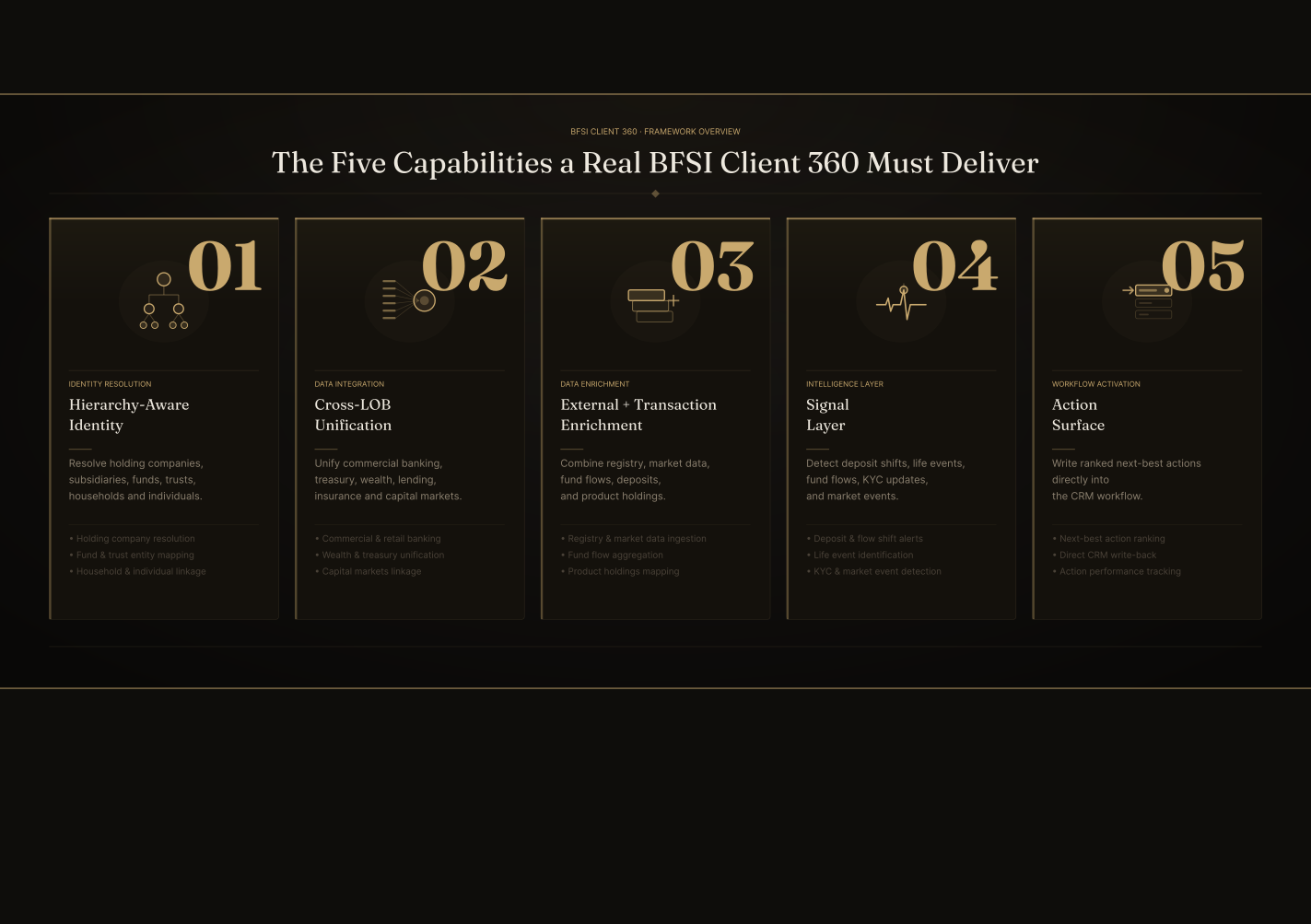
The Five Capabilities a Real Banking Client 360 Must Deliver
A banking Client 360 platform needs five capabilities. Without them, the project may improve visibility, but it will not reliably improve coverage execution.

1. Hierarchy-aware identity. Banks do not sell only to simple account records. They sell into holding companies, operating subsidiaries, funds, SPVs, trusts, households, advisors, consultants, committees, and related entities. A Client 360 platform for banks must resolve those relationships so every signal attaches to the right client structure.
If the system cannot connect a subsidiary deposit change to the parent relationship, or a family trust to the broader household, the 360 view is incomplete before the RM even opens it.
2. Cross-LOB unification. Client opportunity often sits between lines of business. Commercial banking sees one part of the relationship. Treasury sees another. Wealth, lending, capital markets, payments, and product teams may each hold a different piece of the same client story.
A real Client 360 connects those views without forcing every team into a new front-end tool. The value is not just a cleaner profile. The value is seeing where one line of business has context that another team can act on.
3. External and transaction enrichment. CRM activity is only one layer of client context. Banking revenue signals often live in transaction warehouses, core banking systems, product platforms, market data, registry sources, KYC repositories, and news.
A Client 360 that depends only on CRM data becomes stale. A signal-enriched Client 360 shows what changed: deposit patterns, product usage, fund flows, ownership updates, market events, client growth, risk changes, and engagement shifts.
4. Signal layer. A static profile asks the RM to inspect everything. A signal layer tells the RM what deserves attention now.
The platform should detect meaningful changes, score them, connect them to the resolved client hierarchy, and explain why the signal matters. This is where Client 360 moves from data access to buying signal detection in BFSI.
5. Action surface. The output should not be another dashboard the RM has to remember to check. The output should be a ranked next-best action inside the workflow the RM already uses.
That could be a CRM task, opportunity suggestion, call prep brief, outreach draft, account plan update, or follow-up queue. The RM should see the signal, the reasoning, the underlying source data, and the recommended action before approving the next step.
A Client 360 platform that delivers only identity and profile unification is still useful, but it is not yet operational. A platform that delivers all five capabilities becomes the action-ready client intelligence layer above the CRM.
Why Generic Customer 360 Features Fall Short in Financial Services
This section needs careful framing. Salesforce Financial Services Cloud, Microsoft Dynamics 365, and other enterprise CRMs are not the problem. They are important systems of record. The problem is asking them to perform jobs that sit outside the CRM's natural role.
Gap 1 — Banking entity resolution is deeper than standard account matching.
Generic Customer 360 tools can usually model accounts, contacts, and basic parent-child relationships. Banking often requires deeper matching across legal entities, beneficial owners, households, trusts, subsidiaries, funds, advisors, consultants, and counterparties. That requires entity resolution for financial services, not just CRM deduplication.
Gap 2 — The most important signals often live outside the CRM.
A CRM can capture meetings, notes, pipeline, tasks, emails, and service interactions. But many revenue signals in banking come from transaction behavior, fund flows, account activity, product usage, market movement, KYC changes, or external registries. A banking Client 360 must ingest and interpret those signals at the cadence coverage teams need.
Gap 3 — Insight still has to become action.
Many Customer 360 projects stop once the client profile is visible. The RM sees more data, but still has to decide what matters. An action-oriented Client 360 ranks the next step, shows the source signals, and routes the recommendation into the existing CRM workflow with human review.
The right buying-committee framing is not "replace the CRM." It is "make the CRM more actionable." The CRM remains the record of relationship activity. The Client 360 intelligence layer supplies the resolved context, signals, and next-best actions that make the record useful in daily coverage. Teams evaluating this jointly with data-quality initiatives should also look at how dirty CRM data in financial services breaks any Client 360 program that starts on an unresolved substrate.
How a Hierarchy-Aware Client 360 Works in Four BFSI Scenarios
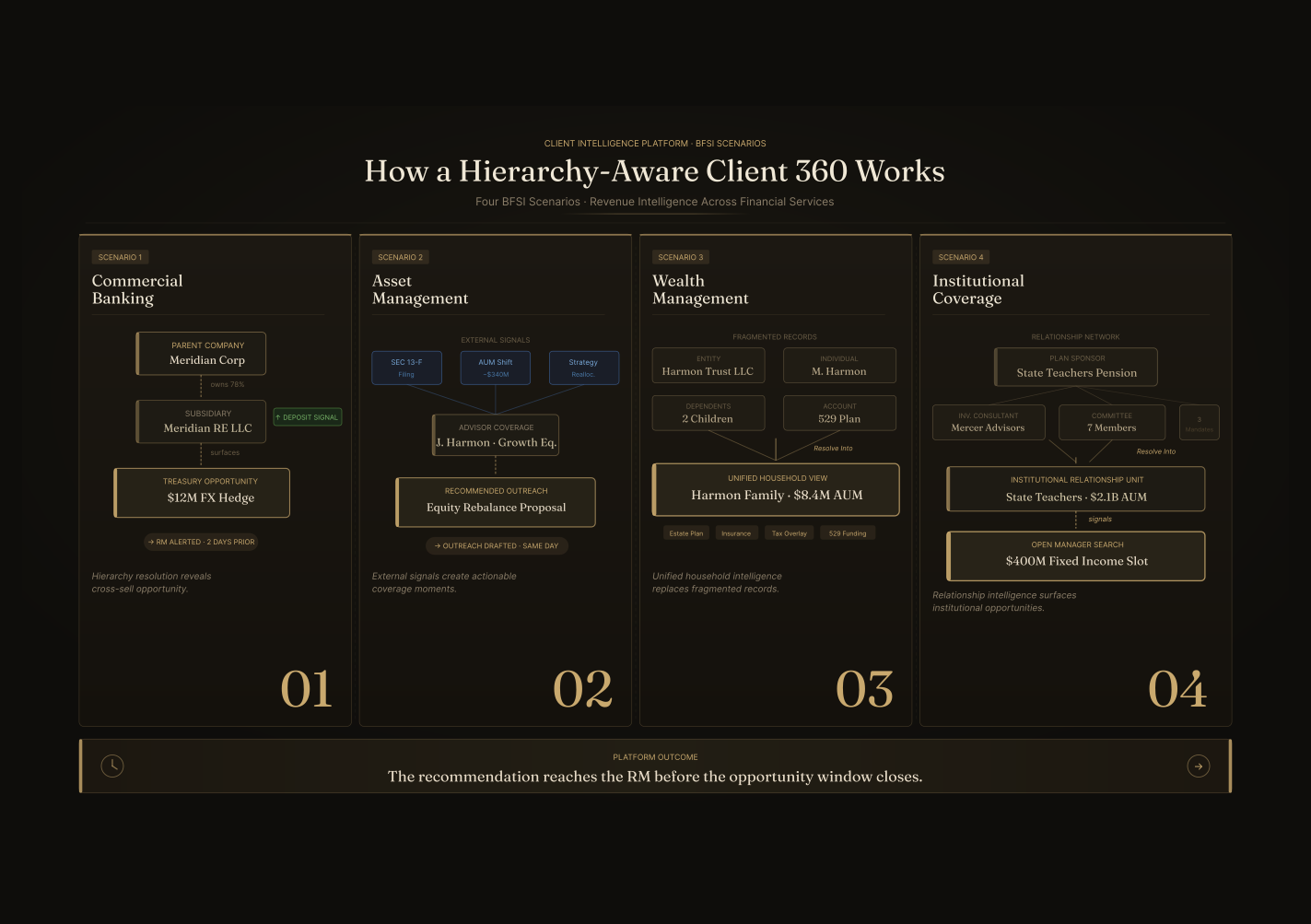
Scenario 1 — Commercial banking treasury coverage. A commercial bank owns the parent-company relationship for a manufacturing group. A regional subsidiary begins carrying an unusually high operating balance, but that subsidiary sits as a separate account in the CRM.
A hierarchy-aware Client 360 connects the subsidiary to the parent relationship, joins the deposit signal to the broader client structure, and creates a CRM-native action for the coverage banker: review the treasury need, identify the right internal relationship path, and prepare outreach to the treasurer.
The RM does not have to discover the signal manually. The system connects the hierarchy, the behavior change, and the coverage motion.
Scenario 2 — Asset management distribution. An asset manager covers hundreds of RIA platforms and advisor relationships. Several platforms begin moving assets away from a competitor strategy into a category where the firm has a relevant product.
A signal-enriched Client 360 connects platform, advisor, product, and fund-flow context. It then ranks the accounts where outreach is most timely and prepares a coverage action for the wholesaler or distribution team.
The value is not just "show me the advisor profile." It is "show me which advisor relationship has a timely reason to engage."
Scenario 3 — Wealth household consolidation. A wealth firm has years of separate records for a family: spouse, matriarch, joint trust, LLC, adult children, and education accounts. Each record looks separate in the CRM, so the advisor cannot easily see the full relationship.
A hierarchy-aware Client 360 resolves those records into a household view, rolls up relationship context, highlights product and concentration patterns, and prompts the advisor with a recommended action before an important liquidity or planning moment.
The advisor gains more than a cleaner profile. They gain a household-level view of what needs attention.
Scenario 4 — Institutional consultant and allocator coverage. An asset manager covers pension, endowment, foundation, consultant, OCIO, and investment-committee relationships. In the CRM, the plan sponsor, consultant, committee members, and active mandates may sit across disconnected records.
A hierarchy-aware Client 360 connects the institutional relationship unit, maps the consultant and decision-maker network, joins mandate and search signals, and creates a ranked coverage action for the consultant-relations or institutional sales lead.
The CRM may show related records. The Client 360 shows the opportunity structure, timing, and action path.
The operational test is the same in every case: did the right recommendation reach the right RM inside the existing workflow, early enough to act, with reasoning the RM could trust?
The Intelligence Layer Above Your CRM
The architecture that turns Client 360 into daily execution is an intelligence layer above the CRM.
It does not replace the CRM. The CRM remains the system of record for relationship activity, tasks, opportunities, notes, and pipeline. The intelligence layer reads from the CRM, joins data from surrounding systems, and writes recommended actions back into the seller's workflow.
It is purpose-built for financial-services data. It must handle entity resolution, legal hierarchies, transaction signals, product holdings, external registry data, market movement, and relationship context. These are not minor add-ons. They are the reason a banking Client 360 platform exists. This is closely tied to how banks build a single source of truth for revenue data in financial services that a coverage team can actually act on.
It keeps humans in the loop. The system can detect signals, rank opportunities, prepare call notes, draft outreach, and suggest next steps. But the RM, advisor, banker, or coverage lead should be able to review the reasoning and approve the action.
SellWizr's Revenue Brain is designed to operate as this action layer: resolving client context, detecting relevant signals, and surfacing AI next-best actions for financial services teams inside existing workflows. The operational grounding of this pattern sits in revenue execution for financial services.
How to Evaluate a Client 360 Platform for Banks
A serious Client 360 evaluation should test the platform against real banking complexity, not a sanitized demo account.
- Hierarchy-aware entity resolution. Can the platform resolve parent companies, subsidiaries, funds, trusts, households, advisors, consultants, and related contacts? Ask for a demo using one of your own multi-entity relationships.
- Cross-system ingestion. Which CRM, core banking, transaction, product, warehouse, KYC, and external data sources can the platform read from on day one? Which require custom work?
- Signal detection. What signals are detected natively? Examples may include deposit shifts, product usage changes, fund flows, market events, ownership updates, client growth, KYC changes, competitor movement, or relationship coverage gaps.
- CRM-native action delivery. Does the platform write recommendations back into Salesforce, Dynamics, or the RM workflow? Or does it require teams to check another dashboard?
- Explainability. Can the RM see why an action was recommended, which source signals were used, and how the resolved client hierarchy was constructed?
- Human-in-the-loop workflow. Can bankers, advisors, and coverage teams review, edit, approve, or reject AI-prepared actions before anything is sent or logged?
- Deployment and governance fit. Can the platform support the institution's data residency, audit, access-control, and model-review requirements?
- Measurement. Can the team track adoption, action completion, conversion, pipeline influence, and signal accuracy over time?
The best evaluation question is not "how good does the dashboard look?" It is "can this platform identify a real client opportunity, explain why it matters, and move the next step into the RM's workflow?" For a broader banking evaluation framework, see the AI sales intelligence platform for banks guide, and for cross-team coverage patterns the ecosystem visibility and Client 360 view.
What Banks Should Measure After Launch
The success of a Client 360 program should be measured by workflow change, not profile views.
Track whether RMs are acting on recommendations, whether signal-driven tasks are completed, whether coverage teams accept or reject AI-prepared next steps, and whether the platform improves the timing and quality of client engagement.
Useful launch metrics include:
- RM adoption rate
- Recommended-action acceptance rate
- Action completion rate
- Time from signal detection to RM action
- Opportunity creation from Client 360 signals
- Pipeline influenced by signal-based recommendations
- False positive and false negative signal feedback
- Cross-LOB referral creation
- Relationship coverage gaps closed
Industry research suggests that banks rewiring frontline workflows around data, AI, and RM action can improve revenue productivity and cost-to-serve outcomes. But those results depend on execution discipline: scoped deployment, instrumented telemetry, clear ownership, and daily workflow adoption.
A bank-wide Client 360 program that tries to solve every line of business at once can stall. A focused rollout that starts with one segment, one coverage team, one product motion, and clear success metrics is easier to prove and expand — a pattern that also shows up in banking coverage use cases and mature relationship intelligence programs.
Conclusion
A real Client 360 platform for banks is not a nicer profile screen. It is the intelligence layer that connects client identity, hierarchy, signals, and action.
The CRM remains essential. The data warehouse remains essential. But neither one automatically tells a relationship manager which client needs attention, why the moment matters, or what step to take next.
That is the job of operational Client 360 intelligence: resolve the client, enrich the view, detect what changed, and turn that context into trusted next-best actions inside the existing workflow.
Banks that treat Client 360 as a dashboard project will keep producing better screens. Banks that treat it as coverage infrastructure will give RMs, advisors, and distribution teams a clearer path from client context to revenue action.
Summary. Client 360 in banking is often delivered as a unified profile UI. A real Client 360 platform for banks is hierarchy-aware, signal-enriched, and action-oriented. It resolves complex client structures, unifies cross-LOB context, enriches profiles with transaction and external signals, detects meaningful changes, and writes ranked next-best actions back into the CRM. Salesforce Financial Services Cloud, Microsoft Dynamics 365, and enterprise data warehouses remain important systems of record and analysis. The Client 360 intelligence layer sits above them to help relationship managers act on client context, not just view it.
FAQ
What is a Client 360 platform for banks?
A Client 360 platform for banks gives relationship teams a unified, hierarchy-aware view of each client and turns that view into action. A real banking Client 360 connects CRM data, product data, transaction signals, external data, and relationship context so RMs can see what changed and what to do next.
How is Client 360 different from CRM?
CRM is the system of record for accounts, contacts, activities, tasks, opportunities, and pipeline. Client 360 is the intelligence layer that resolves complex client relationships, enriches the profile with signals, and recommends next-best actions inside the CRM workflow.
Why do banks need hierarchy-aware Client 360?
Banks often serve clients across parent companies, subsidiaries, trusts, funds, households, advisors, consultants, and committees. Without hierarchy-aware identity resolution, signals attach to the wrong record and relationship managers miss cross-entity opportunities.
What makes Client 360 different in financial services?
Financial services Client 360 requires deeper entity resolution, transaction and product data ingestion, external enrichment, explainable signals, and human-in-the-loop next-best actions. Generic Customer 360 tools often focus more on profile visibility than RM execution.
What data should a banking Client 360 include?
A banking Client 360 should include CRM activity, account and contact data, product holdings, transaction signals, core banking data, fund flows, KYC or onboarding context, market data, registry data, and relevant external events.
How does Client 360 connect to next-best action?
Client 360 provides the context needed for AI next-best action. The platform resolves the client, detects meaningful signals, ranks possible actions, explains the reasoning, and pushes a recommendation into the RM's existing workflow.
Is Client 360 just a dashboard?
No. A dashboard displays client information. A real Client 360 platform for banks detects what changed, explains why it matters, and recommends the next action for the relationship manager.
How should banks evaluate Client 360 platforms?
Banks should evaluate Client 360 platforms on entity resolution depth, cross-system ingestion, signal detection, CRM-native action delivery, explainability, human-in-the-loop workflow, deployment fit, and measurable adoption.
Who owns Client 360 in a bank?
Ownership is usually shared across revenue leadership, relationship management, RevOps, data/IT, and line-of-business leaders. The best programs have one business owner, one technical owner, and clear metrics tied to RM workflow adoption.
How long does a Client 360 implementation take?
Timelines depend on data complexity and scope. The fastest path is usually a focused deployment around one line of business, one coverage team, and one revenue motion before expanding across the institution.
Turn Client 360 from a screen into RM action.
SellWizr helps banking and financial-services teams resolve client hierarchies, enrich client views with revenue signals, and surface AI next-best actions inside existing workflows.