What Is Revenue Execution for Financial Services? The Missing Layer Between CRM Data and Action
Revenue execution for financial services connects fragmented CRM, transaction, product, and client data to entity-resolved next-best actions that relationship managers can review, approve, and act on.
Revenue execution for financial services is the operating layer that turns fragmented account, client, transaction, CRM, product, and external data into trusted next-best actions for relationship managers. It resolves complex BFSI entities, builds context around relationships and signals, ranks the actions that matter most, and prepares work for human review. For banks, asset managers, and wealth firms, the goal is not another dashboard. It is a governed path from scattered client evidence to approved revenue action.
Table of Contents
- What Is Revenue Execution for Financial Services?
- Revenue Execution vs. Revenue Intelligence
- Why Generic Revenue Platforms Fail in Financial Services
- The Six Layers of a Revenue Execution Platform for Financial Services
- What Revenue Execution Looks Like in Practice
- FAQ
Introduction
The financial services industry does not lack revenue data. It lacks a reliable path from data to action.
A commercial bank may see deposit movement in one warehouse, product ownership in another system, hierarchy data in KYC records, coverage notes in CRM, and relationship context in a banker's inbox. An asset manager may know which firms are active, which advisors are redeeming, which consultants are opening searches, and which mandates are at risk — but not in one place, and rarely in time for the right person to act.
That is the problem revenue execution for financial services is built to solve.
The category sits between fragmented BFSI data and the workflows of relationship managers, advisors, wholesalers, bankers, and institutional sales teams. It does not simply summarize what happened. It resolves who the client really is, connects the signals around that client, ranks what should happen next, and prepares the work for human review.
Revenue intelligence helped teams see more. Revenue execution is about doing more with what they see.
For financial institutions, the bottleneck is rarely a lack of investment in CRM, analytics, or AI. The bottleneck is architecture: unresolved entities, disconnected product and transaction systems, uneven CRM trust, and regulated workflows that horizontal sales tools were not designed around. The scale of the underlying data problem is documented in why BFSI sales teams are drowning in fragmented CRM data.
This article defines revenue execution for financial services, explains how it differs from revenue intelligence, breaks down the six platform layers required for the category, and shows what it looks like in asset management, commercial banking, wealth management, and institutional distribution.
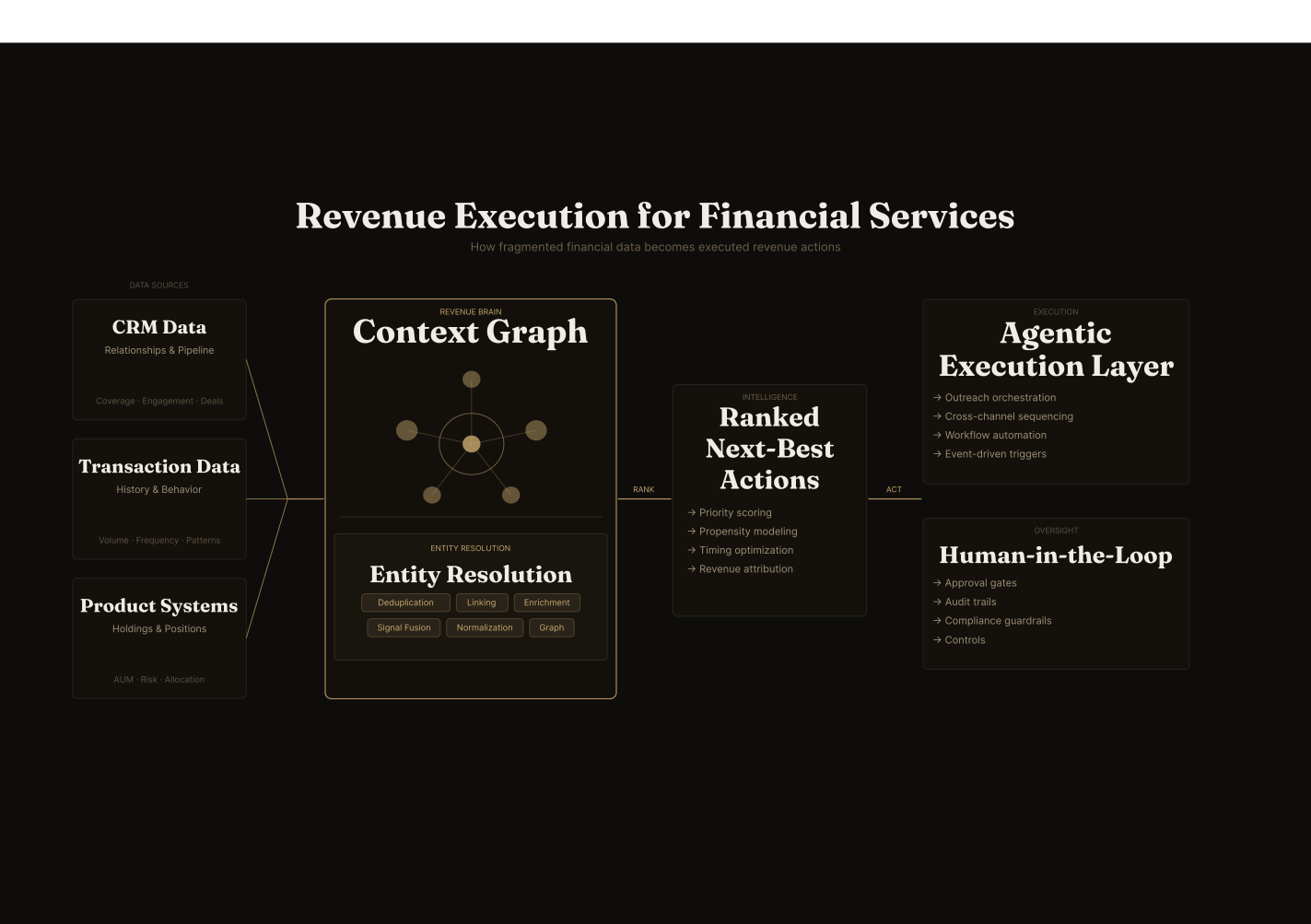
The image shows the architecture of a revenue execution platform for financial services. On the left, three labelled cylinders represent CRM, transaction warehouse, and product systems. Arrows flow into a central node labelled "Revenue Brain - context graph + entity resolution." From the Revenue Brain, ranked NBAs flow to an "Agentic Execution Layer" with an RM-in-loop icon. Three vertical tags on the far right read: Asset Management, Banking, Wealth Management.
What Is Revenue Execution for Financial Services?
Revenue execution for financial services is a category of enterprise software that connects fragmented BFSI data to prioritized, reviewable revenue actions. It is built for relationship-driven financial institutions where clients are not always single accounts, buying signals do not live in one system, and sellers cannot rely on a generic CRM record to decide what to do next.
At a minimum, the category has to do three things:
- Resolve multi-entity client structures into a usable view of the real relationship.
- Build context across products, transactions, coverage, interactions, and external signals.
- Convert that context into ranked next-best actions that can be prepared by AI and reviewed by a human.
It is not the system of record. It is not another outbound tool. It is the execution layer that sits above CRM, data warehouses, product systems, and engagement tools, deciding which actions are worth taking and preparing those actions inside the seller's workflow. The SellWizr platform implements this as Revenue Brain plus DataWizr, but the category is bigger than any one product.
The B2B financial-services interpretation of the term — unifying transactional, product, and relationship data for outbound, multi-entity, regulated selling — is still being defined. Revenue orchestration for SaaS-direct-sales has developed in parallel, and is useful in its own context, but is not modelled around fund flows, KYC, holding-company hierarchies, or governed deployment. Financial-services revenue execution is a distinct motion and needs a distinct architecture.
Revenue Execution vs. Revenue Intelligence
Revenue intelligence platforms are useful because they help teams understand pipeline, calls, accounts, and activity. But most stop at visibility. They surface an insight and leave the relationship manager to interpret it, research the account, write the outreach, and decide whether the signal is worth acting on.
Revenue execution goes one step further. It turns the insight into a decision queue.
The difference is practical, not academic. Revenue intelligence might tell a distribution leader that a high-value RIA has reduced allocation to one product. Revenue execution should identify the advisor, connect the signal to the right firm hierarchy, rank the opportunity or risk, prepare the outreach, assemble the account context, and route the action to the wholesaler for approval.
| Dimension | Revenue Intelligence | Revenue Execution for Financial Services |
|---|---|---|
| Primary output | Insights, scores, summaries | Ranked next-best actions prepared for review |
| Surface | Separate dashboard / app | Human-reviewed execution workflow |
| Data model | Pipeline + conversation | Pipeline + conversation + transactions + product + entity hierarchy |
| Identity layer | Account-level | Multi-entity resolved (holding co, fund, trust, household) |
| Decision logic | Explain what happened | Recommend the next action and prepare it for review |
| BFSI fit | Low - designed for SaaS-style direct sales | High - designed for regulated, relationship-driven motion |
| Workflow effect | RM must context-switch to consume | Prepared action sits inside the RM's workflow for approval |
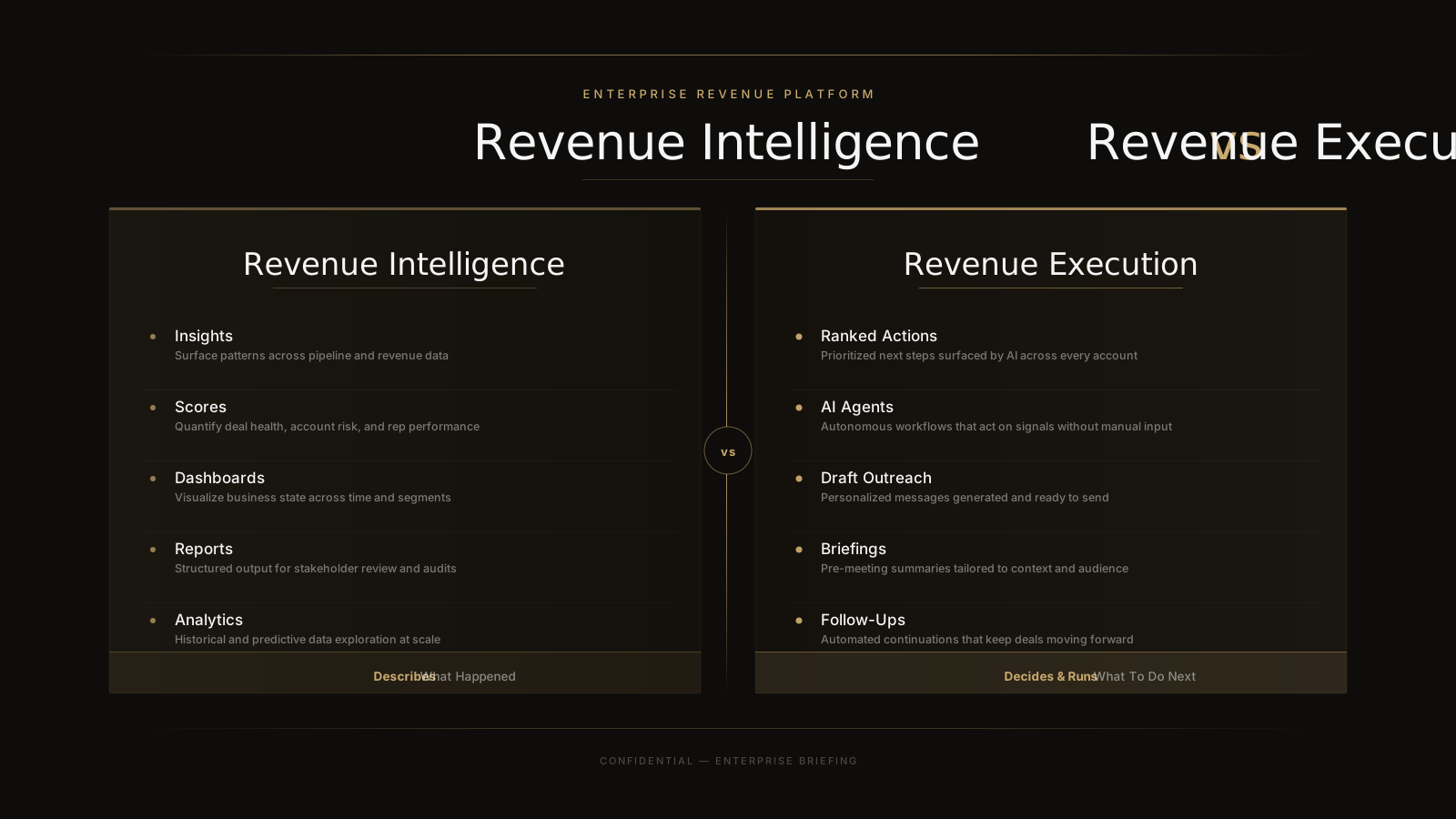
Two-column table. Left column header: "Revenue Intelligence - describe." Right column: "Revenue Execution - decide and prepare." Rows compare primary output, surface, data model, identity layer, decision logic, BFSI fit, and workflow effect.
A Head of Distribution at a mid-sized asset manager who deploys revenue intelligence learns more about their pipeline. A Head of Distribution who deploys a BFSI-specific execution system changes what the distribution team does next Monday morning — because the briefings, outreach drafts, and follow-ups are already assembled and waiting for human review. Insight without a completed action loop is the most common reason AI investments in financial services stall. Revenue intelligence explains. Revenue execution prepares the next step. Related reading: unifying sales signals into a single client view and relationship intelligence for BFSI sales teams.
Why Generic Revenue Platforms Fail in Financial Services
Generic revenue platforms are often effective in the sales motions they were built for: cleaner CRMs, simpler account structures, shorter sales cycles, and high-volume outbound. Financial services works differently. The client is often a hierarchy, a household, a fund complex, a subsidiary network, or an institutional relationship that changes over years. The data is distributed across systems. The workflow is governed. The seller's job is not just to create activity — it is to protect and expand trust.
1. Multi-entity client structures. A wealth client can be an individual, a spouse, a joint trust, two LLCs, and a 529 plan. A commercial banking client can be a parent, three operating subsidiaries, two holding entities, and a treasury vehicle. An institutional client can be a fund complex, a manager, and several vehicles owned by the same allocator. Generic CRMs model these as separate accounts and rely on the seller to manually link them. Until entity resolution for financial services is in place, every downstream signal, score, and recommendation is anchored to the wrong record. Moody's has flagged this directly: "siloed processes within banks overwrite good data with incorrect information, especially for complex companies with multiple levels of legal hierarchy" (Moody's, "Lingering Challenge of Entity Resolution in Financial Services"). More on how this shows up in coverage teams is in multi-entity client relationships.
2. Fragmented product, transaction, and CRM data. Fragmentation in BFSI is not a hygiene problem, it is a structural one. Core systems, transaction warehouses, product platforms, digital channels, KYC repositories, market data, external news, and CRM each hold a partial view of the revenue picture. Horizontal tools assume the CRM is the source of truth. In financial services, the CRM is one of many systems that each think they are. Getting these views into a common shape is what a single source of truth for revenue data in financial services is meant to enable, supported by automated data cleaning and enrichment and internal and external data unification.
3. Relationship coverage, not sequence volume. BFSI selling is long-cycle, relationship-led, and often multi-stakeholder. A treasury opportunity may take twelve months and involve five people at the client and three at the bank. A distribution mandate may span three quarters of consultant meetings, portfolio reviews, and internal approvals. Sales engagement platforms are helpful for delivering outreach at scale, and they have a place in the stack, but they are not the full execution system for a relationship-managed portfolio. Volume of touches is a weak proxy for coverage in this environment.
4. Governed workflows in regulated institutions. Financial institutions run inside internal policies, audit expectations, model-risk review, and data-residency constraints. A workflow that is not reviewable is difficult to deploy at scale. The execution layer needs to support audit trails, access controls, explainability for individual recommendations, deployment flexibility (including institution-managed environments where required), and human approval paths where regulation or internal policy calls for them. This is a design constraint, not a feature bolt-on.
5. CRM confidence breaks before AI scales. If the data underneath the recommendations is not trusted, the recommendations will not be adopted. Validity's 2025 State of CRM Data Management found that a majority of teams say less than half their CRM data is accurate and complete, and a meaningful share attribute lost revenue to that directly (Validity, 2025). Layering AI on top of a CRM the team has stopped trusting compounds the problem. The hidden cost of dirty CRM data in financial services is the failure mode that shows up first when this is skipped.
6. Manual research tax on relationship managers. Industry research puts non-selling time at a large share of an RM's week (Salesforce, State of Sales). The gap is research, hierarchy reconciliation, account hygiene, and manual cross-referencing across systems — exactly the work that an entity-resolved action queue should absorb before any AI recommendation surfaces to the seller.
Generic revenue platforms can still be useful adjuncts inside a BFSI stack. They are not the system that closes the loop between data and action. That is the job of a BFSI-specific execution system, and a closer look at how enterprise BFSI stacks tend to break down is in why financial services sales tech stacks are failing.
The Six Layers of a Revenue Execution Platform for Financial Services
A revenue execution platform for financial services is not one AI feature added to CRM. It is a connected architecture. Each layer reduces ambiguity before the next layer makes a recommendation. If the identity layer is wrong, the signal will be misread. If the context graph is thin, the action will be generic. If the execution layer is not reviewable, the workflow will not fit regulated financial-services teams.
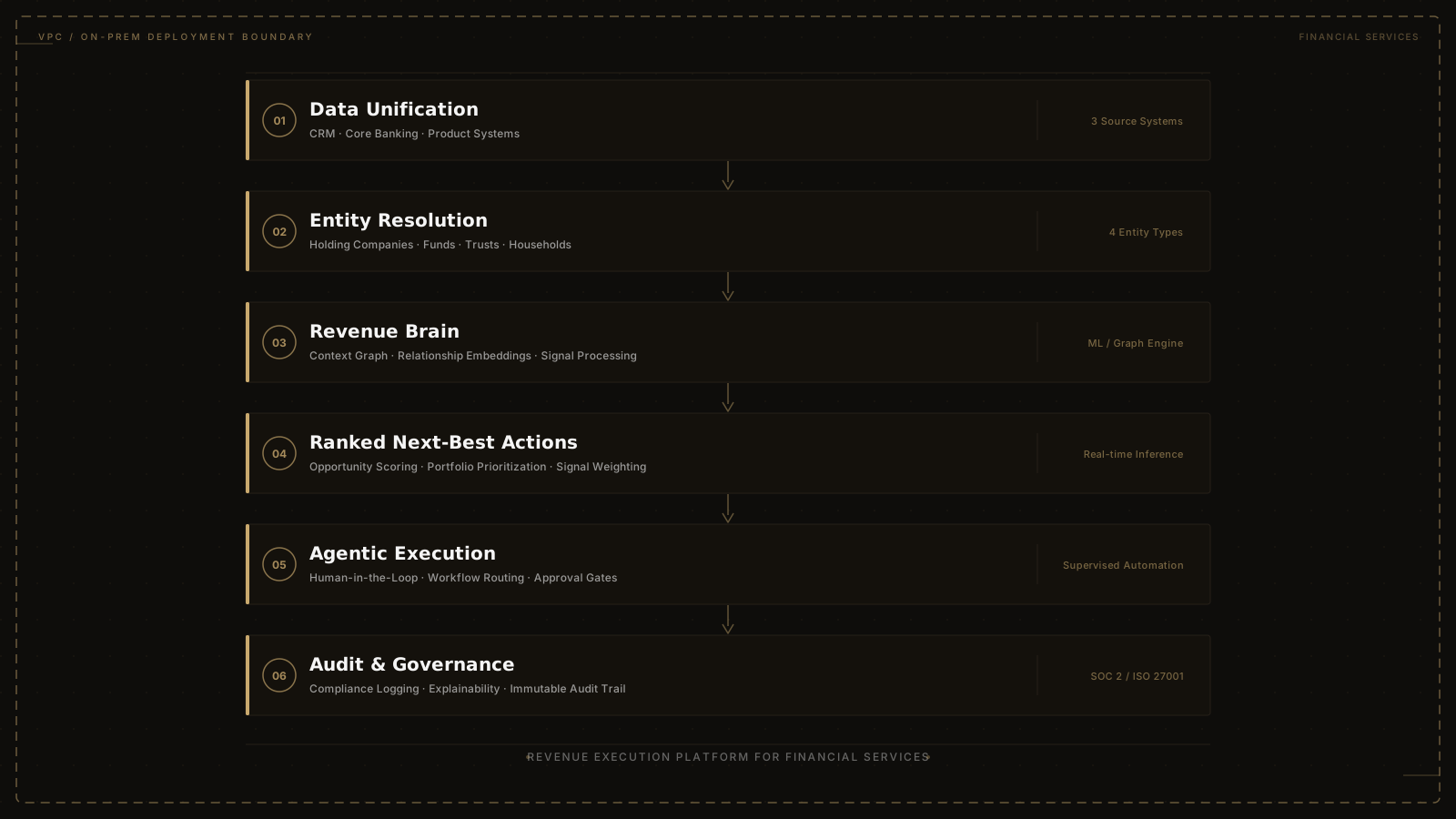
A horizontal six-stage pipeline inside a dashed-border box labelled "Governed deployment perimeter." Stages, left to right: Data Unification -> Entity Resolution -> Context Graph (Revenue Brain) -> Ranked Next-Best Action -> Human-Reviewed AI Execution -> Audit Log. Each stage has a one-line caption.
Layer 1 — Data unification. Ingest and normalize account, client, product, transaction, CRM, and external data — including core banking systems, digital channel logs, KYC repositories, and market or news feeds. The output of this layer is a canonical client schema that later layers can reason over. This is the foundation, and it is where most BFSI AI pilots quietly fail.
Layer 2 — Entity resolution for financial services. Map duplicate, related, and hierarchical records into single resolved entities: holding companies, subsidiaries, funds, family trusts, households, RIAs, advisors, and related parties. Every downstream layer compounds on these relationships, which is why entity resolution has to sit this early. Horizontal CRMs structurally struggle with this because their data model assumes the account is the atomic unit.
Layer 3 — Context graph (Revenue Brain). A semantic graph of clients, hierarchies, products, transactions, interactions, signals, and coverage. The graph is what makes "the treasurer at this subsidiary because the parent's deposit pattern shifted" a computable inference rather than a stored edge. This is the layer SellWizr calls the Revenue Brain; any credible execution platform in this category needs an equivalent structure.
Layer 4 — Ranked next-best action. Generate, score, and rank candidate actions for each resolved client. Rank by expected revenue, product fit, coverage context, eligibility, and recency of signal. Strip the long tail. The output is not a list of leads; it is a ranked queue of decisions ready for preparation. AI next best action financial services workflows only work when Layers 1–3 are in place — otherwise the ranking is optimizing on the wrong evidence.
Layer 5 — Human-reviewed AI execution. AI agents prepare the work behind a recommended action: draft outreach, assemble meeting briefs, summarize account context, pull supporting signals, and queue follow-ups. The relationship manager remains responsible for review, judgment, editing, and approval. This is where execution differs from intelligence: the platform does not only tell the team what to look at; it prepares the next step for the person who owns the relationship.
Layer 6 — Governance and deployment. Financial institutions need revenue workflows that can be reviewed, permissioned, audited, and deployed in ways that fit internal technology requirements. The platform should provide visibility into the source data behind a signal, the reasoning behind a recommendation, and the human approval trail behind an executed action. This is the layer that determines whether the platform is procurable inside a regulated institution rather than confined to a departmental pilot.
A platform that ships only Layers 4 and 5 is a recommendation engine with a thin automation veneer. A platform that ships Layers 1 through 6 is the category. The difference shows up in the first month of production data.
What Revenue Execution Looks Like in Practice
The category is easier to grasp through four operational scenes — drawn from the coverage patterns McKinsey, Forrester, and other analysts have published, not from fabricated customer logos.
Example 1 — Asset management distribution. A mid-sized asset manager's distribution team covers roughly 1,400 RIAs and family offices across North America. The CRM shows all of them as "active." The execution layer resolves firm-level entities to their underlying advisors, joins fund-flow data from the transfer agent, and stitches in recent interaction history from CRM and email. What lands in each external wholesaler's Monday morning action queue is not "1,400 active accounts." It is a ranked short list: a handful of RIAs with new redemption patterns into a competing mandate (defensive call), several with allocation shifts that match the firm's new alts product (cross-sell), and a small number that have not been touched in ninety days despite being top-quintile (coverage gap). Draft outreach, a one-page briefing with portfolio context, and next-step suggestions are prepared for the wholesaler to review, edit, approve, and send. The asset management use case walks through this pattern in more detail.
Example 2 — Commercial banking cross-sell. A regional commercial bank holds a parent-company treasury relationship. A subsidiary across the country signals a treasury-product need through its deposit pattern. In a horizontal CRM, the parent and subsidiary sit as separate accounts and the signal dies quietly. Instead of asking the banker to search across systems, an entity-resolved action layer maps the subsidiary back to the parent, sees the cross-LOB relationship, and prepares the play for the parent's coverage RM: a draft email to the subsidiary treasurer, a briefing note explaining the deposit-pattern signal, and the internal warm-intro path through a colleague who already has the relationship. The RM reviews, edits, and sends. This is the shape of coverage described in banking and lending use cases and in AI sales intelligence for banks.
Example 3 — Wealth management householding. A wealth firm holds a multi-generational family with seven separate records — a matriarch, a spouse, a joint trust, a family LLC, two adult children, and a 529 plan, each opened independently over fifteen years. The advisor's CRM view is whichever record they happen to look up first. The execution layer resolves the seven records into a household entity, connects the trust, LLC, and family relationship view, and surfaces concentration risk across the household. Ahead of a liquidity event that the transaction data is quietly signalling, the advisor sees a ranked coverage action with a consolidated household summary, product context, and a draft outreach — all without manually linking any of the seven records. This is the kind of household-level intelligence discussed in the wealth management use case and in Client 360 for banks.
Example 4 — Institutional asset management distribution. A global asset manager runs a small North America institutional team covering roughly 300 pension funds, endowments, and foundations across a dozen strategies. The CRM is current on meetings; not on much else. Over a weekend, three things happen that matter — a state pension publishes a monthly transaction report that includes a manager termination in a competing category, a Mercer search for a market-neutral strategy appears in the consultant database, and the CIO at an existing endowment client updates her LinkedIn profile. None of it is in the CRM. External signal monitoring pulls each of these events in, entity resolution ties them to the right firm and consultant relationships, and the graph ranks them against the team's coverage. By Monday morning, the institutional team has an action queue of three items, not 300 accounts: a termination-response call with a prepared one-pager, a Mercer introduction request with relationship context attached, and a retention call briefing for the at-risk client. Each outreach is drafted with the relevant portfolio and signal context, and each rep reviews, edits, approves, and sends. Related patterns are in ecosystem visibility and Client 360 and in the broader case for GTM engineering teams in enterprise.
Conclusion
Revenue execution for financial services is the missing operating layer between fragmented BFSI data and the actions that grow, protect, and deepen client relationships.
Revenue intelligence helps teams understand what is happening. CRM records what the team already knows. Sales engagement helps deliver outreach. Revenue execution connects those pieces into a governed workflow: resolve the client, interpret the signal, rank the next action, prepare the work, and keep the relationship owner in control.
For banks, asset managers, wealth firms, and institutional sales teams, the advantage is not simply better reporting. It is a cleaner Monday morning: fewer tabs, fewer missed signals, fewer manual research loops, and a ranked queue of actions ready for review.
See how SellWizr's AI revenue execution platform for financial services connects entity resolution, client context, signal detection, and human-reviewed next-best actions inside existing workflows. For the underlying data problem this category is built to solve, read the related guide on fixing fragmented CRM data in financial services.
Summary. Revenue execution for financial services is the execution layer between CRM data and revenue action, distinct from revenue intelligence (which describes) and sales engagement (which delivers outbound). It is built on six layers: data unification, entity resolution, a context graph (the Revenue Brain), ranked next-best actions, human-reviewed AI execution, and governed deployment. Generic revenue tools — CRM-native AI, account intelligence, conversation intelligence, forecasting, and sales engagement platforms — fail in BFSI because they were designed for SaaS-style direct sales and cannot model fund flows, multi-entity hierarchies, transaction signals, or governed deployment. The BFSI institutions that treat revenue execution as a workflow architecture problem, not a feature, will be the ones whose relationship managers open Monday morning to a ranked, entity-resolved action queue rather than fourteen tabs.
FAQ
What is revenue execution for financial services?
Revenue execution for financial services is the workflow layer that connects fragmented banking, wealth, asset management, CRM, product, transaction, and external data to prioritized revenue actions. It helps relationship managers see which clients need attention, why the action matters, and what should happen next.
How is revenue execution different from revenue intelligence?
Revenue intelligence usually explains what happened through dashboards, scores, summaries, or pipeline insights. Revenue execution goes further by ranking the next action, preparing the work, and keeping the relationship owner in the approval loop.
Why do banks and asset managers need a revenue execution platform?
Banks and asset managers often manage clients across many systems, entities, products, and coverage teams. A revenue execution platform helps resolve those views into actionable context so teams can identify growth, retention, cross-sell, and coverage opportunities faster.
What is AI next best action in financial services?
AI next best action in financial services is a recommended client action based on account context, product fit, relationship history, transaction patterns, eligibility, and recent signals. In revenue execution, the recommendation should be explainable and reviewable by the human relationship owner.
Why is entity resolution important for revenue execution?
Entity resolution connects duplicate, related, and hierarchical records such as subsidiaries, funds, trusts, households, advisors, and parent companies. Without it, signals may attach to the wrong record and the recommended action may be incomplete or misleading.
Is revenue execution the same as sales engagement?
No. Sales engagement tools help teams send outreach and manage sequences. Revenue execution determines which client action should happen, why it matters, and what context should support it before outreach is sent.
Does revenue execution replace CRM?
No. CRM remains the system of record. Revenue execution sits above and around existing systems to unify context, detect signals, rank actions, and push work back into existing workflows.
How is revenue execution different from CRM-native AI?
CRM-native AI usually works within the data and structure already present in the CRM. Revenue execution for financial services must account for data outside CRM, including product systems, transaction data, KYC context, external signals, and complex client hierarchies.
Who owns revenue execution inside a financial institution?
Ownership often spans revenue leadership, RevOps, data/IT, distribution, relationship management, and business-line leaders. The platform affects both business workflows and data architecture, so successful ownership is usually cross-functional.
How should success be measured?
Early success should be measured by action adoption, signal quality, time saved in account research, coverage gaps identified, next-best-action completion, pipeline or revenue influenced, and relationship-manager trust in the recommendations.
See revenue execution for financial services in your workflow.
SellWizr's AI revenue execution platform for financial services connects entity resolution, client context, signal detection, and human-reviewed next-best actions inside the workflows relationship managers already use.