Why BFSI Sales Teams Are Drowning in Fragmented CRM Data
BFSI sales teams struggle with fragmented CRM data because the same client can exist across CRM, core banking, transaction, product, and KYC systems with no canonical, action-ready entity.
BFSI sales teams are drowning in fragmented CRM data because the same client often appears as different records across CRM, core banking, transaction warehouses, product platforms, KYC repositories, spreadsheets, and email. The issue is not just poor CRM hygiene. It is multi-system client data without a canonical, action-ready entity. Fixing fragmented CRM data across financial services institutions requires a layer above the CRM that can resolve entities, connect legal and household relationships, detect revenue-relevant signals, and write ranked next-best actions back into the workflow relationship managers already use.
Table of Contents
- Why Relationship Managers Stop Trusting the CRM
- The Five Fragmentation Patterns Inside BFSI Sales Data
- What Fragmentation Actually Costs
- Why Adding Another CRM Will Not Fix This
- What a Unification Layer Actually Looks Like
- How BFSI Leaders Are Turning Fragmented Records Into Action
- Where to Start — A 90-Day Diagnostic
- FAQ
Introduction
In financial services, CRM data fragmentation is a structural condition, not a maintenance problem. A commercial client, wealth household, borrower, allocator, or treasury relationship may appear across CRM, core banking, transaction warehouses, line-of-business systems, KYC repositories, spreadsheets, and email. Each system may be accurate in isolation, but none of them shows the whole relationship.
That is why fixing fragmented CRM data across financial services institutions cannot be treated as a CRM clean-up project alone. The problem is deeper than missing fields or duplicate contacts. It is an identity, hierarchy, and workflow problem: which record represents the client, which related entities belong to the same relationship, which signals matter, and what action should a relationship manager take next?
The visible symptom is CRM distrust. Relationship managers learn through repeated experience that the record in front of them is incomplete, stale, or attached to the wrong legal entity. The rational response is to route around the system with a spreadsheet, private notes, shared folders, or a manually maintained account log. Over time, these workarounds become the operating layer, while the formal CRM becomes a reporting shell.
This article diagnoses the five structural fragmentation patterns in BFSI sales data, explains what fragmentation costs, and shows why the durable fix is not another CRM. It is a unification layer above the CRM: one that resolves client entities, connects hierarchies, detects revenue signals, and pushes action-ready context back into the systems sellers already use.

A central client icon labelled "Acme Holdings Inc." with seven outbound arrows pointing to seven distinct system labels: the CRM, Core Banking, Wealth Platform, Loan Origination, Treasury Workstation, Excel, Email. Each system shows a slightly different name variant of the same client.
Why Relationship Managers Stop Trusting the CRM
CRM distrust in financial services is not mainly a UX problem. It is a data lineage problem. The relationship manager has learned, often through years of account work, that the CRM record is not the full relationship. It may show one subsidiary but not the parent, one household member but not the trust, one product line but not the treasury activity, or one contact but not the committee behind the buying decision.
That makes the workaround rational. A private spreadsheet, shared document, Outlook folder, Teams thread, or local account log often reflects the real relationship better than the CRM's partial view. The issue is that these workarounds compound. They become where the account truth lives, while the CRM becomes the place sellers update after the fact.
One, the CRM is not the only system holding client truth. Core banking systems, transaction warehouses, KYC repositories, product platforms, servicing systems, and digital channel logs all hold partial views of the same client. The CRM often receives downstream copies at whatever cadence the integration supports. By the time a relationship manager opens the account record, the view may already be incomplete or stale.
Two, the client is not always a single record. A wealth relationship may include a household, trusts, LLCs, children, retirement accounts, and external assets. A commercial banking relationship may include a parent company, subsidiaries, treasury vehicles, and lending entities. The relationship manager thinks in relationships; the CRM often displays accounts, contacts, and opportunities as separate objects.
Three, the entity model breaks first in complex relationships. Holding companies, subsidiaries, funds, SPVs, trusts, institutional allocators, consultants, and committees do not fit neatly into flat CRM records. When the entity model is incomplete, every downstream workflow suffers: coverage planning, cross-sell, next-best action, pipeline attribution, and AI recommendations.
The CRM is not necessarily wrong. It is showing what its model can represent. When the model cannot represent the real financial-services relationship, trust collapses and the spreadsheet wins.
The Five Fragmentation Patterns Inside BFSI Sales Data
Across banks, lenders, wealth firms, asset managers, payments teams, and capital markets organisations, fragmented CRM data usually shows up in five repeatable patterns. Separating the patterns matters because each one points to a different remediation path. A generic "clean the CRM" project treats them as one problem. A proper diagnostic shows which systems, entities, hierarchies, and workflows need to be unified first.
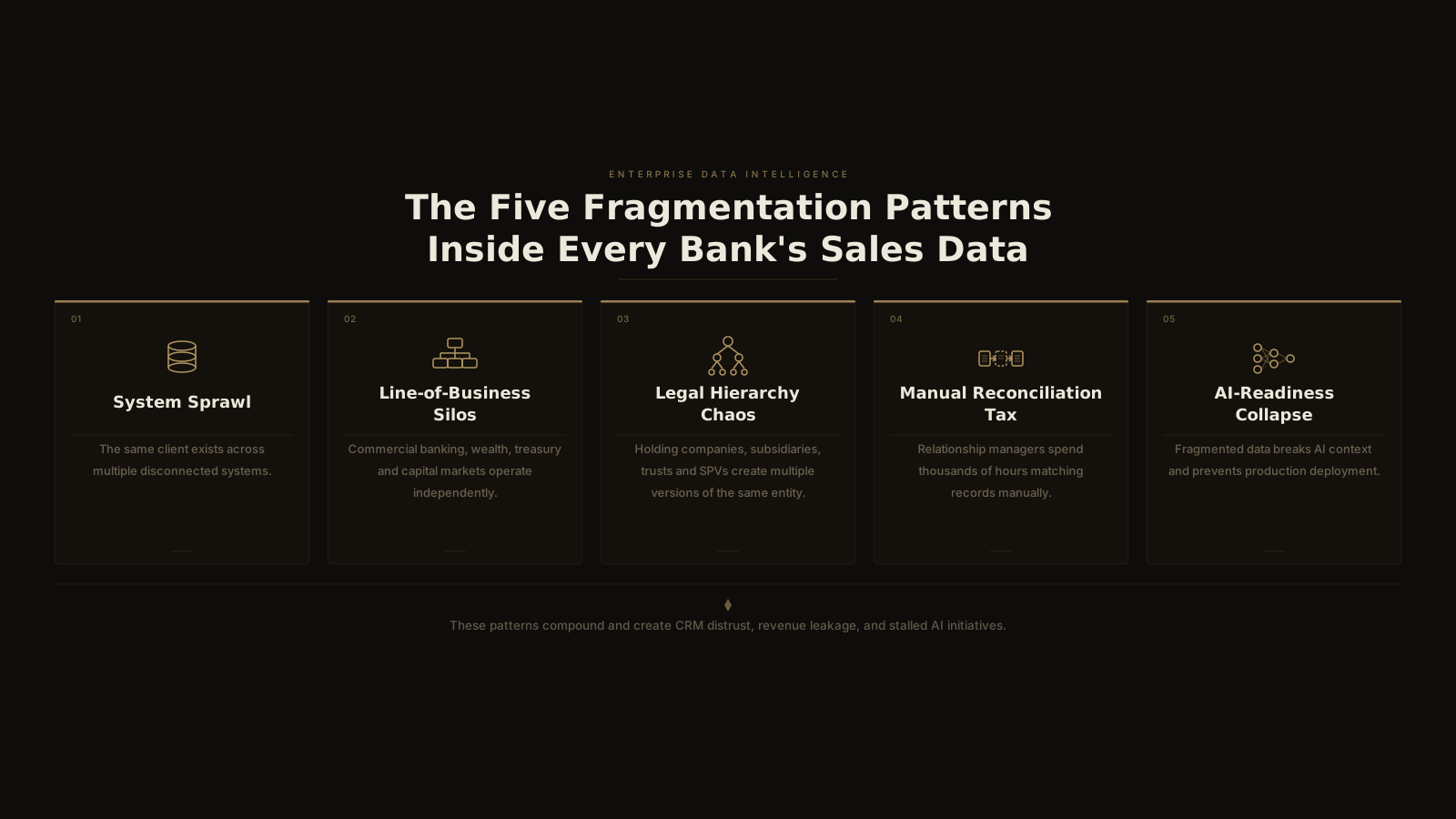
A 5-cell matrix labelled System Sprawl, Line-of-Business Silos, Legal Hierarchy Chaos, Manual Reconciliation Tax, AI-Readiness Collapse — each cell with a one-line description and an example.
Pattern 1 — System sprawl. The same client exists in too many systems: CRM, core banking, lending, wealth, treasury, transaction warehouses, marketing automation, KYC repositories, servicing systems, and spreadsheets. Each system uses its own identifiers and update rules. Reconciliation becomes manual, intermittent, and dependent on institutional memory.
Pattern 2 — Line-of-business silos. Commercial banking, wealth, payments, lending, capital markets, treasury, and asset management may define "client" differently. Each business line can have its own data model, product view, and coverage process. The casualty is cross-line visibility: a team may miss a relevant product need, relationship connection, or revenue signal because it sits outside their system.
Pattern 3 — Legal and relationship hierarchy chaos. Financial-services relationships are rarely flat. A commercial client may include a parent company, subsidiaries, SPVs, treasury vehicles, and regional entities. A wealth client may include a household, trusts, LLCs, beneficiaries, and advisors. An institutional asset-management relationship may include a plan sponsor, investment committee, consultant, OCIO, and related mandates. If those relationships are not resolved, signals attach to the wrong record.
Pattern 4 — Manual reconciliation tax. Relationship managers, analysts, and operations teams bridge system gaps with spreadsheets and local notes. Those files often become the only place where the real client context is assembled. When the owner changes roles or leaves the institution, the operating memory leaves with them.
Pattern 5 — AI-readiness collapse. Every downstream AI initiative depends on the quality of the entity and context layer. Cross-sell scoring, churn prediction, propensity models, next-best action, and account prioritisation all inherit the same upstream fragmentation. If the model receives the wrong client, missing hierarchy, or stale product context, the recommendation will not be trusted.
These patterns compound. The more fragmented the client view becomes, the less credible every downstream recommendation feels. Before a bank can scale AI next-best-action or revenue execution for financial services, it needs a reliable way to resolve who the client is and what relationship context belongs to that client.
What Fragmentation Actually Costs
The cost of fragmented CRM data shows up in three places: missed revenue, wasted relationship-manager time, and stalled AI initiatives.
Dollars. Fragmentation makes cross-sell and expansion harder because product usage, transaction behaviour, relationship hierarchy, and coverage history are split across systems. A commercial banking team may not see treasury opportunity signals. A wealth team may miss household-level context. An asset-management team may not connect a consultant relationship to an existing mandate. The revenue does not disappear in one obvious failure; it leaks through missed timing, missed context, and missed ownership.
Time. Relationship managers lose time reconciling records before they can act. They check the CRM, compare it with product systems, ask operations for confirmation, review spreadsheets, and rebuild context before outreach. The larger the institution, the more this becomes a hidden operating cost.
Stalled AI. AI does not fix fragmented source data by itself. If an institution wants reliable AI next-best-action in financial services, the model needs resolved entities, clean hierarchies, current product holdings, and signal context. Without that foundation, pilots may look promising in controlled demos but fail when relationship managers see recommendations tied to the wrong account or incomplete relationship.
For a CFO or CRO, the point is simple: fragmented CRM data is not only a data-quality issue. It is a revenue-capacity issue. Every quarter the institution operates with an unresolved client view, sellers spend more time reconstructing context and less time acting on it. This is a different failure mode from dirty CRM data in financial services, where the fields inside one system are inaccurate; fragmentation is about the client being split across many systems in the first place.
Why Adding Another CRM Will Not Fix This
The default response to CRM distrust is CRM replacement. In financial services, that rarely solves the root problem. The issue is not that Salesforce, Microsoft Dynamics, or another CRM cannot manage accounts, contacts, opportunities, and activities. The issue is that the CRM is not the authoritative source for every piece of client truth.
One, the CRM is not the root system for every client signal. Transaction data may live in the warehouse. Product holdings may live in product platforms. KYC data may live in a compliance system. Lending data may live in origination or servicing systems. A new CRM does not automatically become the master for any of those systems.
Two, CRM migration recreates the same fragmentation if identity is unresolved. Moving records from one CRM to another does not automatically resolve duplicate clients, legal hierarchies, household relationships, or line-of-business definitions. Without an entity-resolution layer, the new CRM inherits the old ambiguity.
Three, replacement is slower than the revenue problem. A full CRM replacement can take years, especially in regulated institutions. Meanwhile, relationship managers still need better client context, cleaner ownership, and more actionable signals inside their current workflow.
The correct architecture is additive, not replacement. Keep the CRM as the system of record for sales workflow. Add a unification layer above it to resolve client entities, enrich the relationship view, detect signals, and write action-ready recommendations back into the CRM.
What a Unification Layer Actually Looks Like
A unification layer above the CRM has four functional blocks. Skip any of them and the layer is incomplete.
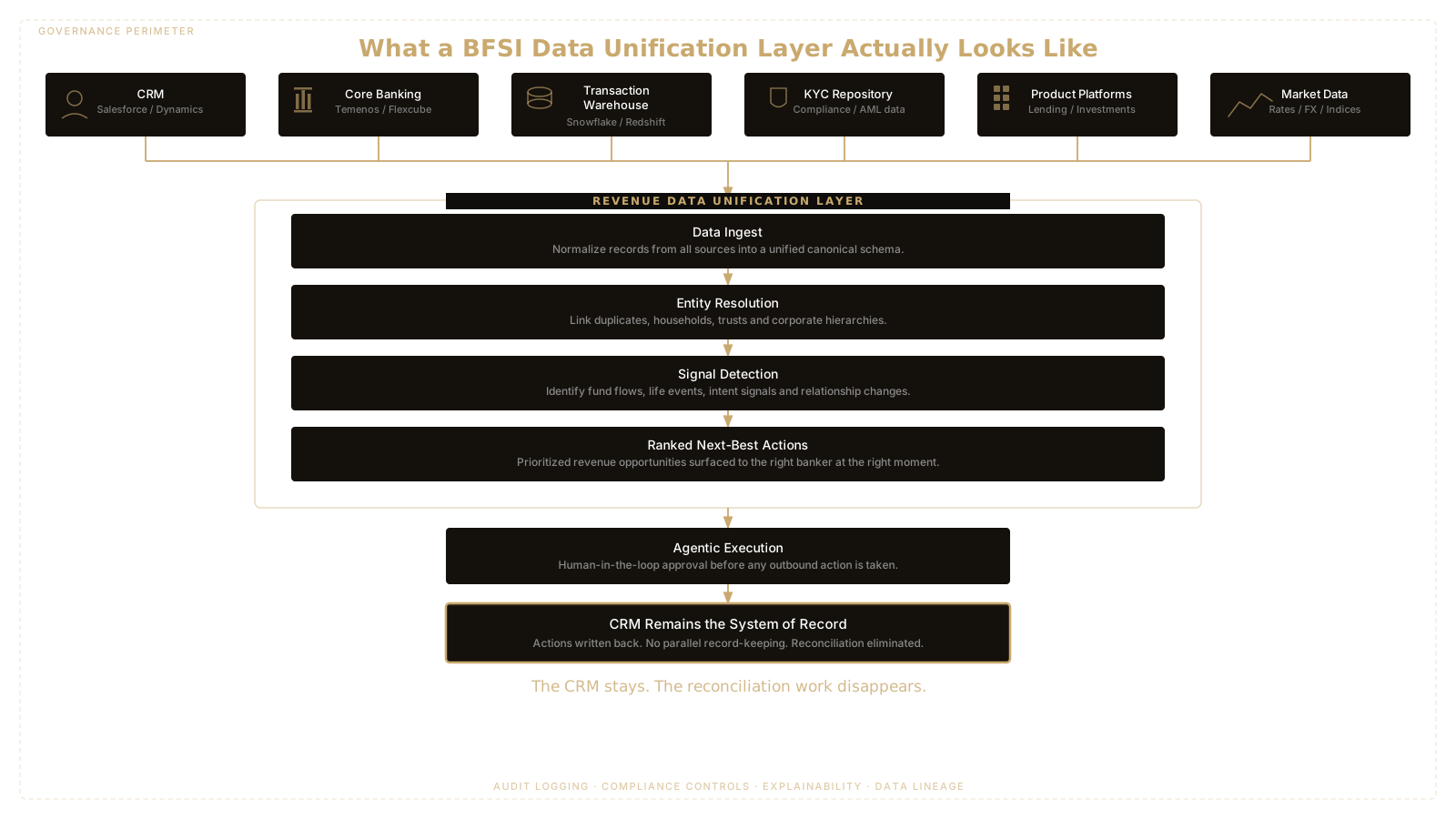
A three-layer stack. Top: CRM as system of record. Middle: Unification Layer (Ingest → Entity Resolution → Signal Detection → NBA Ranking → Agentic Execution Layer with HITL). Bottom: Source Systems (Core Banking, Transaction Warehouse, KYC, Product). Arrows show data flow into the unification layer and an RM-approval loop at the agentic execution stage.
1. Multi-system data ingest. Pull from CRM, core banking, transaction warehouses, product systems, lending platforms, KYC repositories, digital channels, and relevant external data. Normalise the inputs into a client schema that can support relationship-level decisions, not just reporting. This is where client data unification begins — the ingest layer sets what every downstream step can see.
2. Entity and hierarchy resolution. Resolve duplicate, related, and hierarchical records into canonical client entities. This includes companies, subsidiaries, funds, trusts, households, committees, consultants, and other relationship structures that matter in BFSI. Where deterministic keys exist, use them. Where they do not, use explainable probabilistic matching with confidence scoring and review workflows. Practical entity resolution for financial services has to model these relationships explicitly, not flatten them into single accounts. Field-level record hygiene inside each resolved entity is a related but narrower problem, closer to automated data cleaning and enrichment.
3. Signal detection against resolved entities. Attach transaction changes, product usage, fund flows, deposits, corporate actions, KYC updates, life events, market movements, and intent signals to the resolved client entity. Score those signals based on revenue relevance and relationship context.
4. Human-in-the-loop action orchestration. Use the resolved entity and signal context to prepare ranked next-best actions, account briefs, follow-up drafts, and pre-meeting insights. Keep the relationship manager in control: review, edit, approve, and act inside the workflow they already use.
This is where SellWizr fits into the architecture. SellWizr is an AI revenue execution platform for financial services that sits above existing CRM and data systems to resolve fragmented client context into action-ready recommendations. The CRM remains the system of record; SellWizr helps make the record usable for relationship managers, advisors, and revenue teams building toward revenue execution for financial services.
How BFSI Leaders Are Turning Fragmented Records Into Action
The institutions making progress are not treating fragmentation as a generic data-engineering backlog. They are choosing one frontline revenue domain, resolving the client context that matters for that domain, and measuring whether better data changes seller behaviour.
A practical first deployment might focus on commercial banking treasury, wealth household expansion, asset-management distribution, or payments cross-sell. The scope should be narrow enough to prove value but complex enough to test real fragmentation: multiple systems, multiple entity types, and real relationship-manager workflows.
The success criteria should be operational, not abstract. Did the relationship manager trust the recommendation? Did the resolved hierarchy reveal a missed relationship? Did a signal turn into a qualified conversation? Did the CRM become easier to use because the right context was written back into the existing workflow? For a broader treatment of what "trusted" looks like at the reporting layer, see single source of truth for revenue data; for the deeper architectural view, see revenue infrastructure engineering; and for how these decisions land inside a bank-specific evaluation, see AI sales intelligence for banks.
Where to Start — A 90-Day Diagnostic
A serious unification programme begins with a 90-day diagnostic. The output is not a slide deck; it is a sequenced plan for turning fragmented CRM data into a trusted operating layer for one revenue team, with measurable workflow and pipeline outcomes.
Days 1–15 — Client-record inventory. Identify every system that stores client, account, household, product, transaction, or coverage data. For a sample of 100 representative relationships, count how many systems each relationship appears in and how many conflicting versions exist.
Days 16–45 — Fragmentation pattern diagnosis. Map the institution against the five patterns: system sprawl, line-of-business silos, legal hierarchy chaos, manual reconciliation tax, and AI-readiness collapse. Prioritise the two patterns creating the most visible revenue leakage or workflow pain.
Days 46–75 — Unification scope. Choose one line of business and one revenue motion. Define which systems will be ingested, which entities must be resolved, which signals matter, and where the recommended action should appear for the relationship manager.
Days 76–90 — Production path and measurement. Define the first production deployment, required review workflows, data-quality thresholds, and success metrics. Measure seller adoption, recommendation action rate, opportunity creation, and whether the CRM becomes more trusted as the resolved context improves.
The output should not be another data-quality slide deck. It should be a sequenced plan for turning fragmented CRM data into a trusted operating layer for one revenue team, with measurable workflow and pipeline outcomes.
Conclusion
BFSI sales teams are drowning in fragmented CRM data because the same relationship is split across too many systems, entity models, and informal workarounds. The CRM is only where the problem becomes visible. The root issue is that financial-services client relationships are more complex than the systems built to represent them.
Replacing the CRM does not resolve the parent company, subsidiary, household, trust, product, transaction, and coverage context that sits outside it. The more durable fix is a unification layer above the CRM: multi-system ingest, entity and hierarchy resolution, signal detection, and human-in-the-loop next-best action.
The institutions that make progress will not start with a five-year migration. They will start with a focused diagnostic, choose one revenue domain, resolve the client context that matters, and write better actions back into the workflow relationship managers already use.
Summary. Fragmented CRM data in BFSI is a structural condition: the same client appears across CRM, core banking, transaction warehouses, product platforms, KYC repositories, spreadsheets, and email. It decomposes into five patterns — system sprawl, line-of-business silos, legal and relationship hierarchy chaos, manual reconciliation tax, and AI-readiness collapse. Replacing the CRM does not fix any of them, because the client truth lives outside the CRM. The durable fix is a unification layer above the CRM: multi-system ingest, entity and hierarchy resolution, signal detection against resolved entities, and human-in-the-loop next-best action written back into the workflow. Start with a 90-day diagnostic scoped to one line of business and one revenue motion.
Ready to diagnose where fragmented CRM data is slowing your revenue team? SellWizr helps financial-services teams resolve client entities, connect multi-system relationship context, and turn trusted signals into next-best actions inside existing workflows. Start with one line of business, one revenue motion, and one measurable path from fragmented records to action.
FAQ
What is fragmented CRM data in financial services?
Fragmented CRM data in financial services means client, account, household, product, transaction, and relationship information is split across systems such as CRM, core banking, lending, wealth, KYC, transaction warehouses, spreadsheets, and email. The CRM may show one partial view, but not the full relationship context needed for revenue action.
Why do BFSI sales teams struggle with fragmented CRM data?
BFSI sales teams struggle because financial-services relationships are complex. A single client may include parent companies, subsidiaries, trusts, households, SPVs, committees, consultants, and multiple product relationships. Most CRMs were not designed to resolve all of that context across every source system.
Why doesn't replacing the CRM fix fragmented client data?
Replacing the CRM does not automatically resolve duplicate entities, legal hierarchies, product-system data, transaction records, KYC data, or line-of-business definitions. Without a unification layer above the CRM, the new CRM can inherit the same fragmented data model.
What is client data unification?
Client data unification is the process of ingesting client information from multiple systems, resolving duplicates and related entities, connecting hierarchy and relationship context, and producing a trusted client view that can support workflow, reporting, and next-best action.
How does entity resolution help financial services sales teams?
Entity resolution helps financial services sales teams identify when multiple records refer to the same client, household, company, subsidiary, trust, fund, or related relationship. This makes CRM records more trustworthy and allows signals, product holdings, and coverage history to attach to the right entity.
How does fragmented CRM data affect AI next-best-action?
AI next-best-action depends on accurate client identity and context. If the model sees the wrong account, incomplete hierarchy, stale product holdings, or missing transaction signals, the recommendation will not be trusted. Data unification and entity resolution make AI recommendations more usable for relationship managers.
What is the best first step for fixing fragmented CRM data?
The best first step is a focused diagnostic. Identify every system holding client data, sample representative relationships, measure duplicate and conflicting records, map the main fragmentation patterns, and choose one revenue motion where unified client context can produce measurable value.
What is the difference between dirty CRM data and fragmented CRM data?
Dirty CRM data usually refers to inaccurate, outdated, duplicate, or incomplete fields inside the CRM. Fragmented CRM data is broader: the correct pieces of the client relationship may exist, but they are spread across multiple systems with no canonical entity or connected relationship view.
Ready to diagnose where fragmented CRM data is slowing your revenue team?
SellWizr helps financial-services teams resolve client entities, connect multi-system relationship context, and turn trusted signals into next-best actions inside existing workflows. Start with one line of business, one revenue motion, and one measurable path from fragmented records to action.