Why Financial Services Sales Tech Stacks Are Failing Enterprise Teams
Financial services teams do not need another point tool. They need a clearer revenue stack architecture that reduces overlap, protects CRM trust, and turns account data into governed seller action.
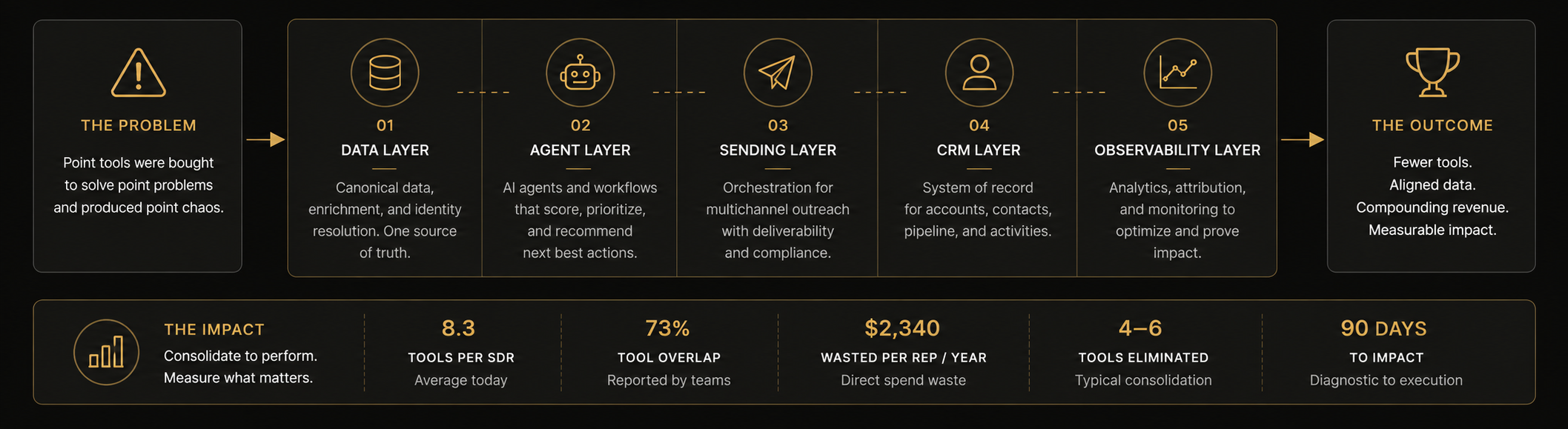
Banks, wealth firms, asset managers, lenders, and payments teams have added tool after tool to improve sales execution. The result is often the opposite: overlapping platforms, conflicting account data, low CRM trust, and AI initiatives that cannot act on a clean revenue picture.
Enterprise sales tech stacks are failing because point tools were bought to solve isolated problems, then left to operate without a shared architecture. In financial services, that problem is magnified by multi-LOB data, long procurement cycles, CRM governance requirements, and relationship teams that need trusted context before they act.
The answer is not another sales tool. It is a stack audit and consolidation plan built around clear ownership: which layer owns data, which layer detects revenue signals, which layer recommends action, which layer records seller activity, and which layer measures outcomes. For BFSI teams, that architecture is what separates a bloated sales stack from a usable revenue execution system for financial services.
Table of Contents
- The Sales Tech Audit Nobody Wants to Run
- How Big Did the Stack Get?
- The Five Failure Patterns Inside Every Enterprise Sales Stack
- Why Point Tools Produced Point Chaos
- The Consolidation Playbook
- Why Financial Services Stacks Are Harder to Consolidate
- The 90-Day Sales Tech Consolidation Diagnostic
- FAQ
Introduction
Enterprise sales technology stacks were not designed. They were accumulated.
A bank adds an enrichment provider for commercial banking. A wealth team buys a client engagement tool. A payments team adopts an intent data source. A lending group adds its own CRM workflow. Each decision makes sense locally. Over time, the institution ends up with overlapping tools, conflicting account views, duplicate enrichment sources, and no clear answer to a basic question: which system should the revenue team trust?
That is why sales tech stacks fail. Not because every tool is bad, but because the stack lacks architecture.
For financial services teams, the stakes are higher than generic SaaS. Relationship managers, advisors, institutional sellers, and revenue leaders need governed account context, clean client hierarchies, reliable CRM updates, and signals that can be explained. If the stack cannot reconcile the same company, household, fund, intermediary, or client group across systems, AI does not fix the problem. It simply moves bad context faster. The deeper structural view is in fragmented CRM data in financial services.
The consolidation path is not a vendor swap. It is an operating decision: define the stack layers, assign ownership, remove overlap, and decide where revenue intelligence becomes revenue action. For many BFSI teams, that means moving from a collection of disconnected point tools toward an enterprise revenue execution platform designed for financial services workflows.
This article diagnoses the five structural failure patterns inside enterprise sales stacks, explains why point tools created point chaos, shows why BFSI stacks are harder to consolidate, and provides a 90-day diagnostic for revenue, RevOps, GTM engineering, and data leaders.
The Sales Tech Audit Nobody Wants to Run
The audit nobody wants to run is usually the one the CFO can defend.
Every tool has a sponsor. Every sponsor has a reason the tool was purchased. Every renewal has a history. That is why stack cleanup often gets delayed until a new CRO arrives, a budget cycle tightens, or an AI initiative exposes the underlying data problem.
Why the audit gets avoided. Cutting a tool is rarely just a software decision. It can affect team workflows, vendor relationships, reporting dashboards, enablement programs, and executive commitments. RevOps teams are often asked to keep the stack running, not challenge whether the stack should exist in its current form.
What the audit reveals. Most enterprise teams find a familiar pattern: tools with no clear owner, tools with overlapping features, tools bought for use cases that no longer exist, and tools that collect useful data but do not influence seller action. In financial services, the overlap is often hidden across lines of business. Commercial banking, treasury, wealth, payments, lending, and capital markets may each own part of the revenue stack without seeing the full cost of duplication.
The framing CFOs accept. Do not position consolidation as a simple cost-cutting exercise. Position it as the architecture required for the revenue strategy and AI roadmap the business already wants to run. The goal is not fewer tools for the sake of fewer tools. The goal is fewer disconnected systems, clearer ownership, better seller adoption, and measurable revenue workflow improvement.
The audit should produce three things: a defensible number, a defensible architecture, and a defensible execution sequence.
How Big Did the Stack Get?
Sales tech stack bloat rarely happens in one budget cycle. It builds through years of local decisions.
One team buys enrichment. Another buys engagement. Another buys forecasting. Another buys intent. Another adds a reporting layer because the CRM cannot answer the question directly. Each purchase appears reasonable in isolation. Together, they create a stack where several tools claim to know the same account, score the same opportunity, or recommend the next seller action.
The exact cost varies by company size, licensing model, and adoption. But the pattern is consistent: overlapping tools create direct software waste, indirect integration cost, and seller productivity drag.
For financial services teams, the cost is not only software spend. It also appears as:
- relationship managers working from incomplete client views
- advisors switching between systems before a client conversation
- institutional sellers relying on spreadsheets for account context
- RevOps teams reconciling pipeline and activity data before leadership reviews
- AI projects delayed because the data foundation is not trusted
A lean stack is not necessarily a small stack. It is a stack where every layer has a purpose, every system has an owner, and every seller-facing workflow can be traced back to trusted data.
The Five Failure Patterns Inside Every Enterprise Sales Stack
Stack failure usually shows up in five patterns.
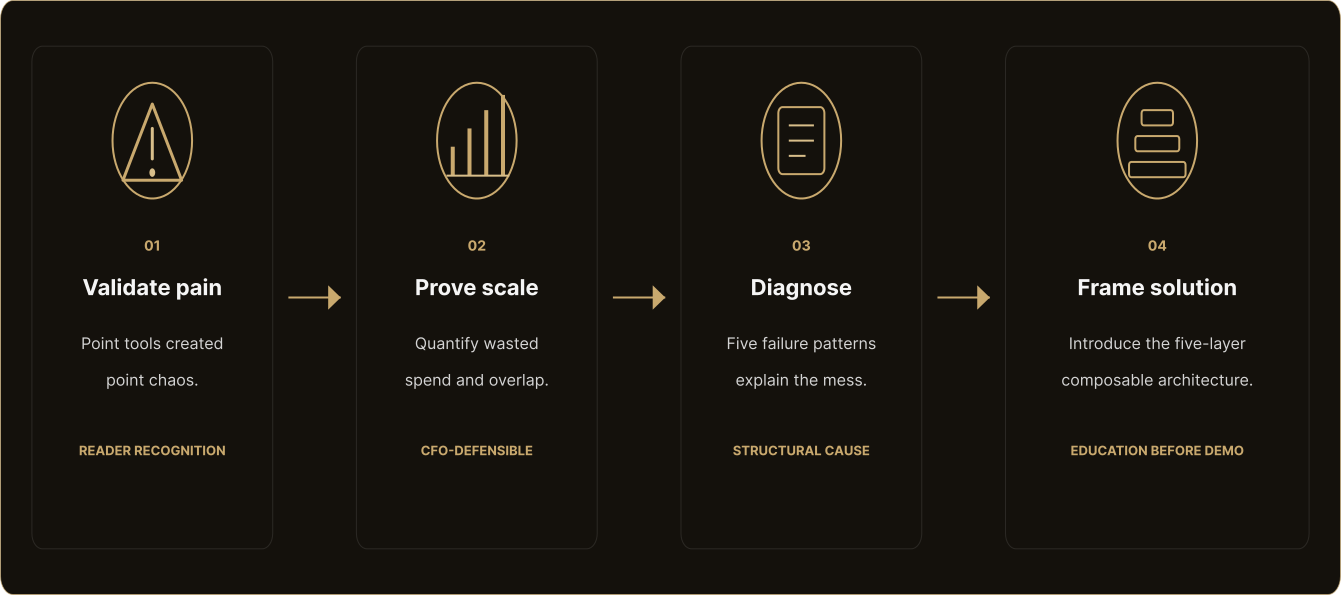
Pattern 1 — Tool sprawl tax. The visible problem is too many tools. The deeper problem is duplicated function. If multiple systems enrich the same account, score the same prospect, recommend the same outreach, or create parallel activity records, the team is paying for complexity twice: once in vendor spend and again in operating friction.
Pattern 2 — Integration debt. Most sales stacks are held together by sync rules, field mappings, custom objects, manual exports, and one-off integrations. This works until business rules change, a field definition shifts, or a line of business adds another workflow. In BFSI, integration debt is especially painful because client, household, account, intermediary, and legal-entity relationships do not map cleanly into simple CRM objects. See entity resolution for multi-entity client relationships for how this problem shows up in practice.
Pattern 3 — Data divergence. Each system stores its own version of the customer. CRM has one view. The warehouse has another. The engagement platform has a third. Product systems and transaction systems may have the most current behavior but the weakest seller visibility. When no layer owns the canonical account view, every forecast, campaign, and AI model inherits the disagreement. The pattern is examined in single source of truth for revenue data.
Pattern 4 — AI on fragmented data. AI does not solve a fragmented stack by itself. If the inputs are inconsistent, the output will be hard to trust. A model may surface a next-best action, but the seller will ignore it if the account hierarchy is wrong, the signal is stale, or the recommendation cannot be explained.
For financial services teams, this matters because sellers need confidence before acting. A banker, advisor, or institutional salesperson cannot rely on a recommendation that does not reflect the actual client relationship.
Pattern 5 — Adoption ceiling. When the stack costs more time than it saves, teams route around it. They use spreadsheets, inbox notes, private trackers, and direct messages. CRM becomes a reporting shell instead of an operating system. Once that happens, leadership loses visibility into the real revenue motion.
These five patterns compound. A team can tolerate one or two for a while. When all five appear together, the company is already in a consolidation program whether it has named it or not.
Why Point Tools Produced Point Chaos
The problem is not vendor malice. It is procurement physics.
Point tools are bought by teams solving local problems. The SDR team wants better enrichment. Marketing wants intent. Sales enablement wants conversation data. RevOps wants forecasting. A banking line of business wants a workflow tailored to its products. A wealth team wants advisor-specific client engagement.
Each decision can be rational. The combined system can still fail.
The issue is that most point-tool purchases answer the question, "Does this tool solve our immediate problem?" They do not always answer the harder questions:
- Which system owns the account record?
- Which tool is allowed to update CRM?
- Which data source wins when records conflict?
- Which signals are trusted enough to trigger seller action?
- Which layer measures whether the action worked?
- Which systems should be retired when capability overlaps?
Without those answers, integration becomes next quarter's problem. Renewal becomes easier than cancellation. The CRM strategy becomes a slide deck instead of an operating model. Eventually, the stack becomes expensive to maintain and hard to believe.
That is why the fix is architectural. The team has to decide how the revenue stack should work before deciding which tools should stay. The function that usually owns that decision is described in the rise of GTM engineering teams.
The Consolidation Playbook
A working consolidation does not begin by ripping out vendors. It begins by defining the job of each layer.
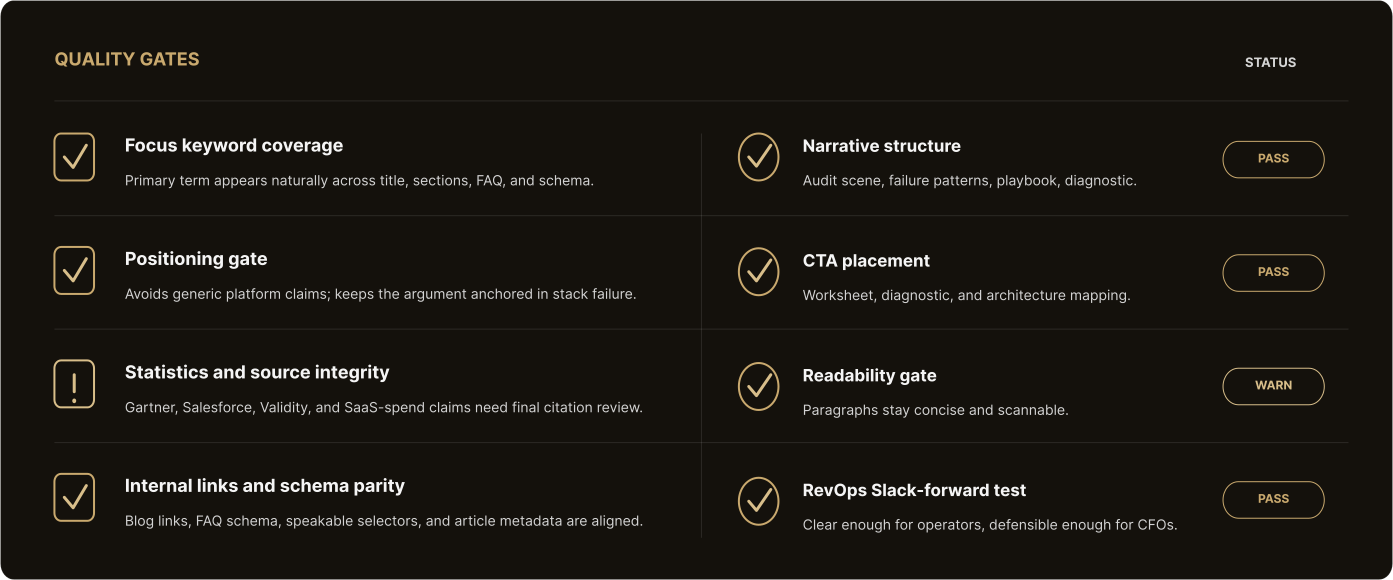
Step 1 — Name the operating layers. For financial services revenue teams, the stack should answer five questions:
- Where does trusted account and client data live?
- Where are entities, hierarchies, and relationships resolved?
- Where are buying signals and revenue opportunities detected?
- Where are seller actions recommended and activated?
- Where are outcomes measured and fed back into the system?
This is where an AI revenue execution platform for financial services should be evaluated. It should not be treated as another point tool. It should be assessed based on whether it can connect trusted data, signal detection, next-best-action, CRM activation, and human review. The reference platform architecture describes how these layers fit together.
Step 2 — Map every tool to a layer. List every sales, marketing, data, enrichment, engagement, forecasting, and intelligence tool. Then map each one to the layer it actually serves.
The overlap becomes visible quickly. If three tools enrich the same account, two tools score the same opportunity, and four tools push seller tasks into CRM, the team does not have a capability gap. It has an ownership gap.
Step 3 — Decide what becomes canonical. Consolidation fails when teams remove tools without deciding what replaces their authority. Before retiring a system, define the canonical source for:
- account and entity identity
- hierarchy and relationship mapping
- activity and engagement data
- buying and revenue signals
- seller recommendations
- CRM updates
- revenue outcome tracking
This is especially important in BFSI, where legal entities, households, fund families, intermediaries, subsidiaries, advisors, and relationship owners can all affect how revenue action should be assigned.
Step 4 — Consolidate around workflows, not features. Feature-by-feature consolidation leads to vendor debates. Workflow-based consolidation leads to operating clarity.
The question is not, "Which tool has more features?" The better question is, "Which workflow should this stack make easier for a banker, advisor, institutional seller, or revenue leader?"
That shift changes the consolidation conversation from software inventory to revenue execution.
The deeper architectural treatment is in revenue infrastructure engineering.
Why Financial Services Stacks Are Harder to Consolidate
Financial services stacks are harder to consolidate because they were often built across lines of business, product groups, and operating models.
One, multi-LOB sprawl multiplies duplication. Commercial banking, lending, treasury, payments, wealth, asset management, and capital markets may each maintain their own tools, workflows, and client definitions. The same company can appear differently depending on which line of business owns the relationship.
Two, procurement cycles slow replacement. Once a vendor has passed security, legal, data, and procurement review, removing it is rarely simple. Even if the tool is no longer ideal, replacing it can require another long review cycle.
Three, relationship data is structurally complex. A financial-services client is not always a single account. It may be a household, a business entity, a parent company, a subsidiary, a fund sponsor, an intermediary, or a multi-product relationship across teams. Generic sales tools often struggle with this complexity.
Four, governance requirements raise the cost of messy workflows. Teams need explainable processes, reliable records, and clear ownership. If seller action is driven by unclear data or conflicting recommendations, adoption suffers.
That is why BFSI consolidation cannot be handled as a simple SaaS cleanup. It needs a revenue-stack architecture that respects how financial-services relationships, data, and workflows actually operate.
The 90-Day Sales Tech Consolidation Diagnostic
A practical consolidation starts with a 90-day diagnostic.
Days 1–15 — Build the inventory. Create one list of every tool that touches sales, marketing, client data, seller workflow, enrichment, intelligence, engagement, forecasting, reporting, or CRM activation.
Capture:
- owner
- business unit
- annual spend
- renewal date
- user count
- primary workflow
- CRM integration
- data source
- outputs created
- adoption level
The goal is not perfection. The goal is visibility.
Days 16–30 — Identify overlap and ownership gaps. Map each tool to the operating layer it serves. Then flag overlap.
Look for:
- multiple enrichment sources
- duplicate account scoring
- conflicting seller alerts
- parallel engagement tools
- unused licenses
- tools with no clear owner
- tools that collect signals but do not drive action
This is where the team separates useful capability from duplicated complexity.
Days 31–60 — Define the target architecture. Before cutting vendors, define the desired state.
Decide which systems own:
- client and account identity
- entity resolution
- revenue signal detection
- seller recommendations
- CRM updates
- workflow activation
- performance measurement
For BFSI teams, this is also the right point to evaluate whether a revenue execution platform for financial services should sit between data systems and seller workflows.
Days 61–90 — Build the execution roadmap. Turn the audit into a 6–9 month roadmap.
Sequence actions by:
- renewal date
- business risk
- user impact
- data dependency
- migration complexity
- expected savings
- workflow value
The final output should be a roadmap the CFO can defend, the CRO can sponsor, RevOps can execute, and sellers can actually feel in their day-to-day workflow.
Conclusion
Enterprise sales tech stacks are failing because point tools were added faster than operating architecture was defined.
The symptom is tool sprawl. The causes are deeper: integration debt, data divergence, AI built on inconsistent inputs, and sellers who no longer trust the systems they are asked to use. In financial services, those problems become harder because client relationships are multi-entity, multi-product, and often spread across lines of business.
The fix is not another point solution. It is a stack audit, a consolidation roadmap, and a clearer execution layer between trusted data and seller action.
The CRO who runs the audit now will have a cleaner revenue operating model before the next renewal cycle. The team that waits will keep paying for overlap, reconciling conflicting data, and asking why the newest tool did not solve the oldest architecture problem.
Summary. Financial services sales tech stacks fail when too many point tools operate without a shared architecture. The common failure patterns are tool sprawl, integration debt, data divergence, AI on fragmented data, and low seller adoption. BFSI teams face added complexity because client relationships span lines of business, entities, products, and workflows. The solution is not another point tool. It is a 90-day stack diagnostic that identifies overlap, defines canonical ownership, and builds a consolidation roadmap around revenue execution for financial services.
FAQ
Why are financial services sales tech stacks failing?
Financial services sales tech stacks fail because tools are often purchased by separate teams without a shared architecture for account data, CRM ownership, signal detection, seller workflow, and outcome tracking.
What is sales tech stack bloat?
Sales tech stack bloat happens when multiple tools perform overlapping functions, create duplicate data, and add workflow complexity without improving seller productivity.
Why is sales tech consolidation harder in banking and financial services?
Financial services teams manage complex client relationships across entities, households, products, business units, and governed workflows, which makes tool replacement and data ownership harder than in many horizontal sales environments.
What is integration debt in a sales tech stack?
Integration debt is the operational burden created by fragile syncs, custom mappings, duplicate fields, and disconnected workflows across sales, marketing, CRM, and data systems.
Can AI fix a broken sales tech stack?
AI can help only when it has trusted data, clear context, and governed workflows. If the underlying data is fragmented, AI may produce recommendations sellers do not trust.
Should financial services firms replace their CRM?
Usually not first. CRM should remain the seller-facing system of record, but firms often need a cleaner data and execution layer around it.
What should a sales tech audit include?
A sales tech audit should include tool inventory, owner, renewal date, annual spend, user count, workflow purpose, CRM integration, data source, adoption, and overlap with other systems.
What is the first step in consolidating a sales tech stack?
The first step is mapping every tool to its operating layer: data, identity, signal detection, seller action, CRM activation, and measurement.
Ready to audit your revenue stack before the next renewal cycle?
SellWizr helps financial services teams connect trusted account data, revenue signals, and seller workflows so consolidation becomes an operating plan — not just a software cleanup.